



By Cliff Rold
There’s nothing more special in boxing than the sort of genuine heavyweight kingpin who combines the promise of excitement with the lure of box office dollars.
When we don’t have one, devoted fight fans tie themselves in knots trying to explain why it’s no big deal. Heavyweight fights often disappoint, they might say. The ‘pound for pound’ whoever is more skilled, they’ll exclaim.
Both those things can be true and so can an assortment of other critiques of boxing’s big men. It doesn’t matter. Only one boxer can ever truly be the baddest man on the planet, the one from whom they can run but not hide, the man who can lick any son of a botch alive.
That boxer is the heavyweight champion of the world.
While the situation atop the division today is still a little muddy, all signs point to the UK’s Anthony Joshua as having a chance to meet the heavyweight ideal in a way no fighter has since Mike Tyson in the late 1980s. WBA/IBF titlist Anthony Joshua (19-0, 19 KO) is good looking, athletic, puts butts in seats, knocks the hell out of opponents, and is poised to go truly global. His fantastic war with Wladimir Klitschko proved his mettle and added a quality punctuation mark to his early ledger.
Joshua isn’t just the man of the moment. He’s a man with options ending in a lot of zeroes. There are other fighters with belts, other fighters with some big wins, but no one who is as in demand as he is right now.
The other sides of any Joshua equation increase their chances of getting to him by creating demand of their own. Nothing creates demand like big time victories.
Someone might have one by the end of the year.
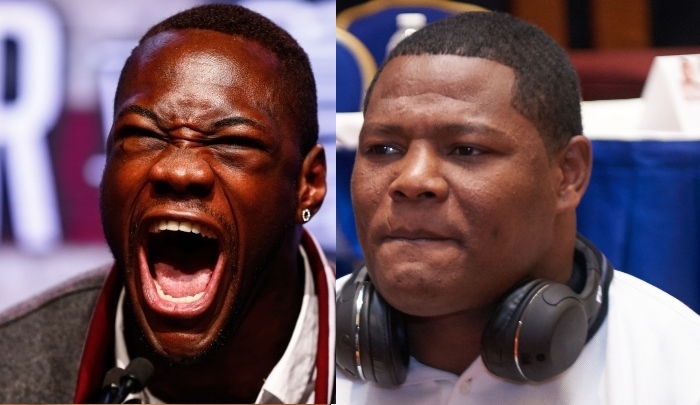
As reported here by Keith Idec on Tuesday, we may be on the verge of seeing 31-year old WBC titlist Deontay Wilder (38-0, 37 KO) tackle the toughest opponent of his career in Cuba’s 38-year old Luis Ortiz (27-0, 23 KO).
Or not.
As also reported by Rick Reeno, 38-year old WBC mandatory, and the man Wilder won his belt from, Bermane Stiverne (25-2-1, 21 KO) might not be willing to step aside to let that fight happen. Stiverne, who has won only one fight since the lopsided January 2017 loss to Wilder, has not been in a boxing ring since November 2015. That’s almost two years Somehow, that’s enough for a WBC mandatory.
There’s no clamor for this sequel but Stiverne’s position shouldn’t be a surprise. When Wilder was a mandatory to Stiverne, he didn’t have a win over anyone then currently rated in the WBC’s top forty. A cursory scan doesn’t locate any of the names in the July 2017 WBC top forty on Stiverne’s record. Fighters in their top ten have wins over other currently rated fighters; Stiverne just isn’t one of them.
There is little appearance of meritocracy.
To be fair, Stiverne was supposed to fight an eliminator/interim title fight with Alexander Povetkin last year. Povetkin tested positive for a performance enhancer and the fight didn’t come off. Stiverne also failed a test earlier on the way to the fight but was cleared to take the fight by the WBC.
And he is their former champion, if pretty well removed. Getting a rematch would be nothing unexpected.
In this case, it would just be in the way of something better. If we get that something better, we might be seeing the beginnings of an overall Joshua effect at heavyweight.
It would be good news for the sport.
The emergence of a star is never a bad thing in any division. At heavyweight, the lure of potential riches is often greater. When a star emerges at a time when big men are showing some depth, it forces more fights to happen.
We saw it in the early 1990s. Fighters like Lennox Lewis, Ray Mercer, and Tommy Morrison didn’t just wait their turn for a crack at a Tyson or Evander Holyfield. They took some genuine risks not just to rise in the ratings but also to increase their market value. They knew it wasn’t enough to be good. They went about creating demand.
Some waited longer than others. Others never quite got there. Lewis’s win over Razor Ruddock didn’t get him an earned shot at Riddick Bowe and a loss to Oliver McCall set him back. He eventually got the big money, and the titles, by taking fights that kept him sharp and relevant.
We saw it again in the late 90s and early 2000s when David Tua, Chris Byrd, the Klitschko brothers, Hasim Rahman, Oleg Maskaev, Ike Ibeabuchi, and others went at each other in a slew of fights. They were all ultimately chasing Lewis. It made for some memorable moments.
Wilder-Ortiz would fit into that framework. It’s a risk for both men with a strong reward hanging in the distance. Given his age, Ortiz isn’t in a position where a loss would be easy to rebound from. For Wilder, defeat would move him farther back in a line an Ortiz fight might vault him ahead of.
Despite his belt, Wilder might not be as near the head of the line as his fans might hope. Klitschko still retains his inside track for a rematch with Joshua. While their return bout is not made yet, it could mean a US debut for Joshua that makes him an even more valuable target.
Barring a loss to Klitschko, certainly possible as evidenced in their jaw rocking back and forth first fight, Joshua would then be staring at possible mandatories and a pair of enriching foes not named Deontay. The man who beat Klitschko for the lineal crown, Tyson Fury, says he’s coming back. A Joshua-Fury fight would be every bit the stadium mega-event Joshua-Klitschko was earlier this year.
There is another Fury as well. Hughie Fury (20-0, 10 KO) is challenging WBO titlist Joseph Parker (23-0, 18 KO) in September in Manchester. The winner there would set up yet another multi-million dollar unification possibility.
Wilder, as it stands today, wouldn’t necessarily be any more or less deserving, or profitable, than those potential foes.
Wilder has cache if Joshua were to continue fighting in the US but only if Wilder paid more here than those fights would there (or here). An Ortiz fight would be a high wire attempt to separate from the pack not just as another top guy to fight but also as the one with the best, most immediate claim for a showdown. If Wilder can defeat Ortiz, he would finally have the sort of quality win to validate his impressive accumulation of statistics. Beating Stiverne was okay, but few boxing folks regard Stiverne as highly as Ortiz.
For Ortiz, a Wilder fight would let him rise from his station as a sort of boxing Voldemort. No one says his name unless they have to. He’s not the first rival the press asks Joshua about. A win over Wilder would put his name front and center.
It’s the sort of fight every boxing fan should be crossing their fingers and toes wishing to see before the year is out. Competition can become a contagion. If Wilder and Ortiz raise the bar for what fans can demand on the road to Joshua, the heavyweight division can only get hotter.
Cliff Rold is the Managing Editor of BoxingScene, a founding member of the Transnational Boxing Rankings Board, and a member of the Boxing Writers Association of America. He can be reached at roldboxing@hotmail.com


