Tyson Fury rules out retirement, might sign '10-fight deal'
•Read more

by David P. Greisman
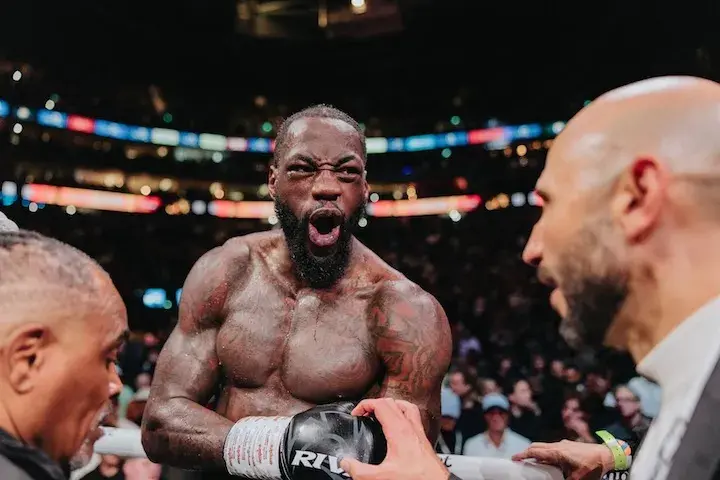
Deontay Wilder was supposed to be in Moscow this week. He was supposed to be days away from stepping into the ring with Alexander Povetkin, the mandatory challenger to Wilder’s world title and a better opponent than anyone Wilder had ever faced before. Wilder was supposed to earn a minimum of $4.5 million dollars, plus another $715,000 if he were to leave Russia as the victor.
He won’t be leaving Russia, because he never flew there.
He never flew there because Povetkin tested positive for a performance-enhancing drug.
The positive test was conducted on April 27. The news of it came out this past Friday, May 13. Wilder was in England at the time, where he had been training for two weeks. That day, the World Boxing Council, whose belt Wilder holds and which Povetkin was to fight for, issued a statement acknowledging the test result.
“The WBC’s priority is and will always be safety, fair play and justice. In order to continue to strive for the absolute safety of the boxers and for a just and fair outcome for all parties involved, the WBC is conducting an in-depth investigation of this matter,” the statement read. “The WBC will make a public announcement in the very near future concerning the results of its investigation and any appropriate steps that it will take.”
But the fight was eight days away. Wilder’s flight was less than two days away. He was supposed to leave Sheffield for Moscow at 8 a.m. on Sunday, May 15. He didn’t, and so hours later the WBC released another statement:
“The World Boxing Council is diligently addressing the positive test result from the Clean Boxing Program for mandatory heavyweight challenger Alexander Povetkin,” the statement read. “Keeping the priority of safety and also the principle of justice, the WBC will continue the investigation into the case. Consequently, the event scheduled for May 21 in Moscow is hereby officially postponed. The WBC will be releasing more information in the coming days regarding the final ruling on the matter.”
The WBC says Wilder-Povetkin has been postponed. Povetkin’s promoter, Andrey Ryabinsky of World of Boxing, claims the bout will be rescheduled. Wilder’s team disagrees with both.
“The fight is off,” said Jay Deas, Wilder’s manager, in a post on Facebook on Sunday afternoon. “Not postponed. Off. We are gutted. All the hard work we put in with the time, effort and money is gone, through no fault of ours. The ripple effect from this cancellation reaches hundreds of people. We will take some time off and be back soon and continue to campaign and demand a clean sport and level playing field.”
It’s bad news, but necessary bad news. We want good fights, and Wilder vs. Povetkin was a good match-up of top heavyweights. Yet we also should demand that our fights are clean fights. This is a brutal sport, yet it is still an athletic pursuit with rules and expectations.
The substance Povetkin tested positive for was meldonium, which according to the New York Times is “believed to enhance endurance and aid recovery by improving blood flow throughout the body.” Those who fight against doping in sports learned about athletes using the substance a little more than two years ago, the report said. By the end of 2014, they were mulling over whether to add it to the list of banned substances. The World Anti-Doping Agency announced at the end of September 2015 that meldonium would be banned as of the start of 2016.
The opening months of this year brought a stunning number of positive tests for meldonium from a number of sports — 172 from Jan. 1 through mid-April — most notably tennis player Maria Sharapova. There were a couple of contributing factors. Meldonium use is apparently prevalent, “sold over the counter in Russia and some Eastern European countries,” according to the New York Times. But beyond that, there was evidence showing that some of the positive tests could’ve come from the substance being used before it was officially illegal.
A WADA notice issued on April 13 said that some of its studies demonstrated that meldonium would be excreted rapidly at first, but that the substance would then leave the system much more slowly, with levels of it remaining in certain ranges “for a number of weeks” and in even lower ranges “for a few months.” WADA’s statement allowed that possibility that some of the punishments issued by various sports’ supervising organizations could be overturned, though it also placed the burden of proof on the athletes to show that their use of meldonium had happened no later than 2015.
That’s what Povetkin’s team claims was the case.
“Alexander Povetkin used to take meldonium in September last year, when the drug was permitted,” World of Boxing officials said on its Twitter account last Friday. “Povetkin has not been taking this drug since January, but theoretically meldonium could remain in the blood.”
Mitch Abramson of RingTV.com, citing unnamed sources, called that claim into question. According to his reporting, Povetkin underwent drug testing on April 7, 8 and 11 that showed no signs of meldonium, only to come up positive on April 27.
For far too long, the only drug testing done in boxing was conducted right before and/or right after a fight. Many athletic commissions still only do that limited amount of testing, if that, and even then they aren’t using the sophisticated (and hence more expensive) testing to catch the presence of more advanced doping. Even still, the best drug testing is done well before a fight, when a boxer is in training. That’s because advantages are gained while a fighter is preparing. A baseball player who can use performance-enhancing drugs to recover from his workouts faster can then lift more and be stronger and faster. A bicyclist who can carry more oxygen in his blood will have more endurance. A boxer benefits from all of the above.
Wilder’s team made the right choice, then. It did come at a cost of money as well as time, plus the wear and tear that Wilder put his body through to prepare for the bout. He will at least be able to somewhat recover financially, given that he still holds the world title and still will be able to appear in headline spots on major American broadcasts. Other fighters don’t have that luxury; it’s little surprise that Orlando Salido is going forward with his June fight against 130-pound titleholder Francisco Vargas even though Vargas also recently tested positive for a banned substance.
Then again, there are big differences between what happened with Povektin and what went on with Vargas. With Vargas, his positive result was for clenbuterol, a substance that has recently led to a number of athletes in Mexico testing positive due to its regular use in livestock feed. The Associated Press reported last month that “Mexican authorities inspected 200 slaughterhouses in 2015 and found clenbuterol in livestock at 58 of them.”
That case at least went before the California State Athletic Commission, which opted to believe that Vargas ate tainted meat, and then ruled that Vargas could still fight so long as he passed additional stringent testing paid for at his expense.
The Wilder-Povetkin purse bid was held at the end of February. Two weeks later, representatives from both fighters’ camps spoke of wanting more stringent drug testing. As far back as last year, Wilder had been quoted as saying of Povetkin: “I think he’s juicing. He’s looking too big. … He’s on some kind of steroids. But, you know, that’s just my opinion.”
But wanting more stringent drug testing and getting it are two different things. According to Dan Rafael of ESPN.com, “The fight nearly fell apart because Ryabinsky insisted on delaying the beginning of the drug testing protocol. … So instead of beginning about 10 weeks before the fight, which was what was agreed to, testing began about seven weeks ahead of the fight.”
We’re much more aware of the use of performance-enhancing drugs now than we were at the turn of the century, thanks not only to star athletes testing positive or being implicated, but also because of just how many others have been caught. We still may only be seeing the tip of the proverbial iceberg. Drug testing is a cat-and-mouse game. Athletes are always looking for ways to cheat without being caught, whether through the way they use or because of getting around how and when the testing is done. The testing depends on the supervising bodies, their willingness to clean up the sport and their ability to pay.
And in several cases, the fox is guarding the henhouse.
When it comes to many sports, countries are in charge of their own anti-doping agencies. Several countries have been found by WADA to be non-compliant, whether due to their doping rules or because of using laboratories that weren’t accredited by WADA. Russia earned that unwanted label after reports of widespread doping, reports that have picked up even more steam with recent revelations about how the country’s athletes were able to get away doping during the Winter Olympics held in the city of Sochi in 2014.
It’s no surprise, then, that Wilder-Povetkin used an independent agency, the Voluntary Anti-Doping Agency, rather than having the testing done by RUSADA.
Right now, the fight is off. Right now, we wait to see if the fight will be off for good.
In the United States, punishment would be up to the state’s athletic commission. Russia’s governing body for boxing could choose to suspend Povetkin. But the WBC also can have a say. Under its rules, the WBC could suspend Povetkin from its rankings for up to one year and take away his position as mandatory challenger to Wilder’s world title.
We’ll wait to see if any additional revelations bear out the reasonable conclusion that Povetkin not only used meldonium but also used it after it had been banned. No matter what, however, Wilder won’t be in Moscow on May 21. He won’t be defending his world title this weekend. He won’t be earning millions of dollars. He, too, is in essence being punished for someone else’s alleged sins.
That’s the way boxing works, just one of the negatives that comes out of two positives — the result of a drug test and the result of a sport trying, finally, to have cleaner competition.
“Fighting Words” appears every Monday on BoxingScene.com. Pick up a copy of David’s book, “Fighting Words: The Heart and Heartbreak of Boxing,” at http://bit.ly/fightingwordsamazon or internationally at http://bit.ly/fightingwordsworldwide. Send questions/comments via email at fightingwords1@gmail.com
 HOT0:12Dubiel Sánchez Round 1 Knockout Of Oliver Quintana19K views
 HOT1:09Would you like to see Pacquiao make his UK debut against Cordina? #Boxing5.7K views
 HOT1:07Does Vergil need to stop Thurman faster than Fundora did to make a statement? #boxing4.3K views
 HOT1:22Should Canelo-Mbilli go ahead as planned, or should the event be postponed? #boxing5.8K views
 HOT1:17Should the event proceed under the current circumstances? 👇 #boxing3K views
 HOT0:59Is Shakur justified in demanding more, or has he priced himself out of a major fight? #boxing8.3K views
 HOT1:12Kevin Anton Defeats Freudis Rojas Jr And Retains WBC Title5.5K views
 HOT0:30Kevin Anton Unloads On Freudis Rojas Jr In Round 105.7K views
 HOT1:16Should Canelo-Mbilli proceed as planned, or should fighter safety take priority? 👇 #boxing9.5K views
 NEW0:49Is it time for Gonzalez to get his world title opportunity? #boxing325 views
 NEW2:22Bryan Flores vs Jonathan Navarro Highlights383 views
 NEW0:54Can Lomachenko still compete with the best at 130lbs, or has Father Time caught up with him? #Boxing2.3K views