Tyson Fury-Anthony Joshua winner: 'Supercomputer' says Fury, body language says Joshua
 Zachariah Delgado/Matchroom
Anyone who has worked within the boxing media will attest to the number of press releases sent out in the hope of gaining attention or clicks.
It should therefore come as no surprise that the eagerly-awaited heavyweight showdown between Anthony Joshua and Tyson Fury – now set for December 11 in Cardiff, Wales – is already proving fertile ground for such marketing material.
Two landed this week that caught my attention, if not yet my endorsement.
The first, received early in the week, concerned a ‘supercomputer’ that “has projected that Tyson Fury will beat Anthony Joshua with a ninth-round stoppage”.
The so-called supercomputer, apparently “conducted” by CanadaCasino, “utilises a combination of mathematical probability algorithms and agentic AI to project the result of the competition.”
Overall, Fury is given a 64.7 per cent chance of victory compared to 33.1 per cent for Joshua, with the draw afforded just a 2.2 per cent chance of occurring inside the Principality Stadium.
It goes even deeper and, in fairness, the round-by-round breakdown of what’s going to happen in 10 weeks’ time makes compelling reading.
In short, Joshua starts fast and wins the first three rounds before being dropped in the sixth. He misses a wild uppercut in the eighth and is rescued by the referee while trapped on the ropes in the ninth.
This so-called supercomputer – aren’t all computers super these days? – brought to mind the NCR 315, a 1960s data-processing system that in 1969 was given the task of determining the winner of a fantasy bout between Muhammad Ali and Rocky Marciano.
An overweight Ali and Marciano, wearing a wig, even lightly sparred in front of the cameras for 70-odd rounds so the results of the ‘fight’ could be revealed on film. It was understood at the time that the supercomputer of 60 years ago favoured Marciano to win but – due to political considerations – films depicting different outcomes were released in different parts of the world.
American and Canadian audiences saw Ali, then banned from boxing because of his stance on the Vietnam War, knocked out in the 13th round. In Europe, where Ali remained popular, Marciano was shown losing on cuts.
If the best software of 1969 could produce various endings to please different audiences, who knows what technology is capable of in 2026, particularly with all-conquering streaming giant Netflix at the helm.
For what it’s worth, I’d be interested in seeing a double knockdown after an all-out slugfest – à la Rocky II – and finding out who gets up first.
Though the modern-day computer likes Fury to win, another press release to land this week makes the case that, no, Joshua is already leading the way.
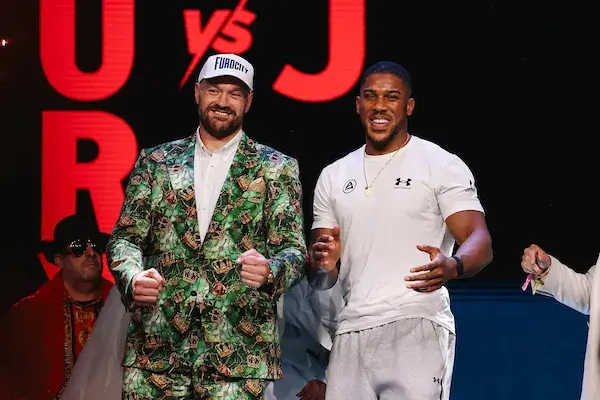
According to ‘body language expert’ Darren Stanton, courtesy of OLBG, Joshua ‘won’ Wednesday’s press conference and has therefore gained the psychological edge that has so often belonged to Fury in the past.
Stanton explains that the always-studious Joshua, with the ever-mischievous Fury alongside him, exhibited signs of maturity and a genuine understanding of self. In the past, Stanton reckons, Joshua might have become too swept up in the pre-fight mind games and tried a little too hard both to appear superior and stamp his authority.
All Stanton saw on Wednesday night, however, was a 36-year-old seemingly at last completely comfortable in his own skin.
“I don’t see arrogance in Joshua. I think he’s been on a journey and learned from his failures,” Stanton explained.
“I see a self-confidence in how he’s presenting himself at this press conference. Joshua is no longer humble, but he has evolved as a person, and as a fighter.
“Joshua knows he needs to defuse Fury, and he’s doing that well so far. Fury seemed a bit diluted. The laughter, the positivity, took him away from his usual areas of strength in these situations.
“I see no expressions or gestures of anger, contempt, neither man seems unsettled, and we know Fury likes to play with people. He tries to get in their heads. He’s psychological and strategic with it but it’s Joshua who looks like the master strategist based on this press conference.”
Stanton closed his findings by analysing the body language of both men during the face-off at the end of the press conference. Joshua was not overawed when Fury performed his usual make-myself-even-taller-by-standing-on-my-tiptoes routine. In fact, Stanton observed that Fury soon mirrored Joshua’s stance as they turned towards the crowd.
“Anthony Joshua may already have the perfect antidote to Tyson Fury and his mind games.”
What the supercomputer will make of these latest findings is anyone’s guess.
But I sure look forward to it landing in my inbox.

Matt Christie, a lifelong fight fan, has worked in boxing for more than 20 years. He left Boxing News in 2024 after 14 years, nine of which were spent as editor-in-chief. Before that, he was the producer of weekly boxing show “KOTV.” Now the co-host of “The Opening Bell” podcast and regularly used in the UK as a pundit, Matt was named as the Specialist Correspondent of the Year at the prestigious Sports Journalism Awards in 2021, which was the seventh SJA Award he accepted during his stint in the hot seat at Boxing News. The following year, he was inducted into the British Boxing Hall of Fame. He is a member of the BWAA and has been honored several times in their annual writing awards.