


 Tweet
Tweet
He was an undefeated boxer, a title contender.
But he couldn’t escape the violence of the West Side.
BY BRYAN SMITH

Leave. Please, Ed. Pack your ****, say your goodbyes, and get outta here. Your family, your girlfriend, your fellow boxers, your managers—especially your managers: We’re scared for you. Too much craziness in these streets. You’ve already been shot three times. What, you think you’re bulletproof?
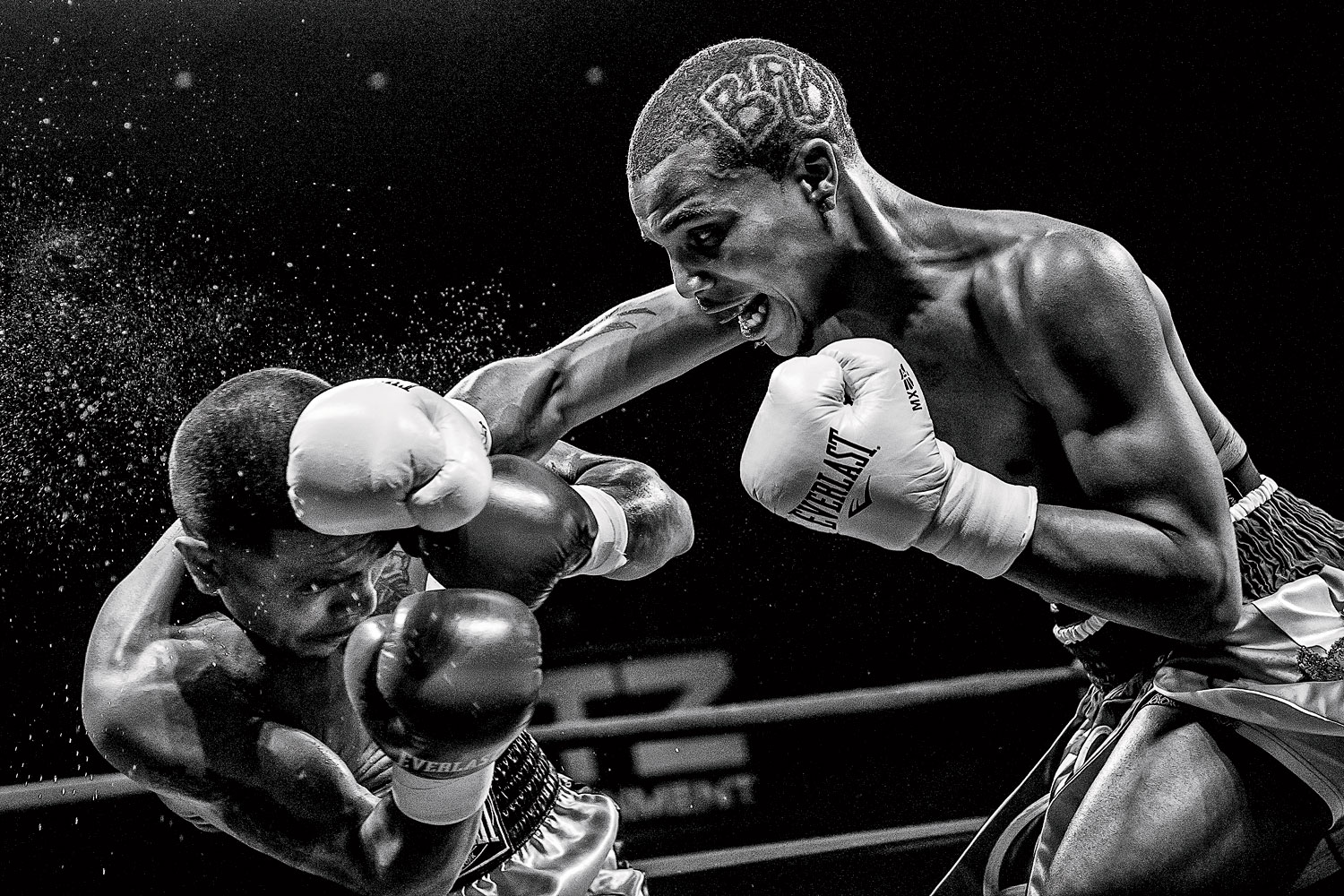
Well, he kinda was, wasn’t he? He’d taken gunshots to his neck, his knee, his ankle—body looking like a connect-the-dots game. Bulletproof. If he didn’t already have a nickname, he might have copped that one, stitched it right on his boxing trunks instead of the one everybody knew him by. Ed “Bad Boy” Brown. Pride of Garfield Park, future champ, silly, joke-crackin’, handsome as Ali, with a right-left combo that hit so hard your whole family would need a standing eight.
“Bulletproof” was sorta funny, when you thought about it. But Brown knew as well as anyone that death doesn’t play. And definitely doesn’t heed a nickname. He knew at just 11 years old, the evening his mother kissed him good night and went to E2, the club on Michigan Avenue, to celebrate her boyfriend’s birthday and never came home—killed with 20 others in a stampede after a security guard tried to break up a fight with pepper spray. “She was a good mama,” Ed would tell the papers the next day, his younger brother crying beside him.
He knew from last October, when his girlfriend’s brother, a guy he’d come to regard as his own sibling, got clipped sitting in a car, not doing anything. He sure knew from his mornings at the boxing gym, when he’d hear other boxers talking—“Did you hear … ?”—or see them pull their shirts up to show their own bullet wounds. He knew from the gym wall, papered with memorial announcements and photos of young men just like him: fists up, hard looks. Bulletproof. Dead.
His comanager and his promoter, one of the biggest in the sport, were offering to stake him to a new life in Vegas, California, anywhere but here. If he’d just say the word.
All right, he vowed. At 25, he had a record of 20–0, with maybe one more fight to get his ranking up and earn some big paydays. Enough to take along his 3-year-old daughter and his girlfriend and maybe even his father, who was back from prison. One more fight and he’d get them all outta here. He’d do what everyone asked. Leave.
But now here he was. Just after 1 a.m. on a Saturday. The streets of Garfield Park spooling past his back-seat window like a documentary, a grainy indictment of all that was wrong with the city, his city. Leave.
The car slowed. His female cousin driving, his friend next to her up front. She eased into a parking spot under the pale cone of a streetlight. Damn. It was getting late. He had to be up early to work out. No half stepping. Too much riding on this next fight.
Then the silver sedan rolled up, slowing just as it reached his cousin’s car. The windows glided down, the gun barrels emerged like snake heads. Aw, no. No.
“Work, work, work. Trabajo! Trabajo. Fuerza, fuerza!” says the short, bald middle-aged man with the salt-and-pepper broom mustache. “The **** you doin’? You standing there! You ain’t gonna win no fights on the ropes.”
Two young boxers, red-faced and glistening under foam headgear, shirts soaked, stalk each other around the ring, lunging, lurching, jabbing, feinting, parrying, punching, then dancing away. One, in a “Team Shorty” T-shirt, stood up by a hard right, unleashes a barrage that sends the other boomeranging off the ropes.
“That’s a freight train,” the man says approvingly from the skirt of the ring. As if looking for confirmation, he turns his head to a smattering of other boxers below the ring in various stages of their workouts: shadow punching, skipping rope, pumping crunches.
At first glance, the Chicago Park District boxing gym in East Garfield Park seems little more than a modest-size, high-ceilinged room marooned at the end of a dim hallway, the ghost of some long-ago administrative headquarters. But a few steps in, the sepia richness of its storied past begins to reveal itself. The space is dominated by the ring, a 24-by-24-foot square of sky-blue canvas bearing the words “Corona Extra” and set about four feet off the floor, the corner poles resting on dingy, barf-beige industrial tile littered with boxing gear. From an adjacent room comes the da-da-ta-da-da-ta-da-da-ta of a speed bag being worked. From another, the thuds of a heavy bag.
Roaring above all, though, is the ringside commentary—a mix of drill sergeant commands, professorial patter, and standup routine—of the middle-aged man, George Hernandez. Dressed in striped Adidas track pants and a Chicago Park District polo, this West Side Mussolini looks every bit the part of the bellicose trainer–slash–father figure that has made him an icon in local boxing circles. The City of Chicago might technically run the place, but this is his gym, just ask.
“This ain’t no goddamn democracy,” he bellows to no one in particular. “What I say goes up in this mother****er!”
One of the boxers launches a sharp flurry that recaptures his attention.
“More of that, more of that, there you go!”
And then: “You tired, aren’t you? Took the week off. All you do is **** and eat. All that ***** got your legs ****ed up. You better get your **** together. Donald Trump might deport your ass.”
“I got my papers,” the boxer shoots back.
It was at this same gym, nearly 20 years ago, that a skinny 6-year-old named Ed Brown appeared with his two cousins, arriving like so many boys who find their way here: uncertain, wide-eyed, intimidated, self-conscious—and desperate to hide any hint of that.
The trio were from the neighborhood, long considered one of the city’s poorest and most gang ridden. With rare exception, its appearance matches the statistical gloom: a wrecked landscape of vacant lots and boarded-up houses and caved-in graystones, unrelieved stretches of blasted wasteland studded with gardens of broken glass and clusters of young men on street corners.
From the heart of the desolation rises what at first seems a glittering mirage, a dome gilded with 23-karat gold tiles crowning a splendidly carved Spanish baroque edifice. Flanked by lagoons and blessed with a panoramic view of the downtown skyline, some seven miles off, the structure was originally built in 1928 as the headquarters for the West Park Commission. Like much of the neighborhood, it succumbed to blight and neglect, crumbling brick and falling plaster, but was rescued from demolition at the last moment in the early ’90s. Today, situated next to the Garfield Park Conservatory, it houses a gymnasium, an auditorium, a dance studio, a fitness center, a grand ballroom, and—calling out to kids in need of positive, not to mention safe*, places to hang out—a boxing gym.
Of the three boys who walked in that day in 1997, only Brown stuck. Hernandez is fuzzy on his first encounter with him (“So many come in here,” he says), but it isn’t hard to imagine the moment. “These are tough boys from tough neighborhoods,” he says. “Some are coming from prison, some are dope fiends, gang****ers. I’ve taken guns away from kids. I can’t come off like, ‘Hi, how are you?’ When they come through that door, I have to let them know I’m nobody to play with. I’m the only bully here. You bring that gang****in’ **** in here and out you go. You don’t do what I say, out you go. You think you know better, out you go.”
Hernandez’s approach derived from his own adversity, which included growing up without parents. After separating from Hernandez’s mother, his father dropped him and his three brothers off at a police station, declaring that he didn’t want them anymore. Hernandez became a ward of the state, joined the army, then studied criminal justice and fine arts at Loyola. He learned to fight by fending for himself growing up in group homes.
The blunt-force welcome he unloads on newcomers is intentional—a first chance to take a kid’s measure. “You don’t got no heart, no balls, we run you out of here,” he says. The payoff for those who don’t get scared off or pissed off is acceptance into a sort of surrogate family. “What you can’t find at home, I try to give them here,” Hernandez says.
Ed Brown ingratiated himself from the get-go: “He was really funny and goofy, already cussing up a storm at 6 years old,” Hernandez recalls. He was also eager to learn. “He was like a sponge. He would pick up everything.”
Even as a boy, Brown was fierce, “always getting into fights at the park—and winning,” says boxing writer Bill Hillmann, a former Golden Gloves champion who began tracking Brown’s career early on. That’s why Brown’s family steered him toward Hernandez and the gym. “They thought they could turn that anger into something positive.”
And they did. At age 8, Brown, weighing 60 pounds, won a Silver Gloves title, the under-16 equivalent of the Golden Gloves. He also claimed an Illinois Junior Olympic championship. For him boxing was, at first, just something to do. It was only when he saw he had a gift for it, he told a television interviewer years later, that he fully committed: “It gave me confidence.”
The shattering news of his mother’s death, however, upended everything. Hernandez dropped any pretense of tough love. “We just started becoming close,” he says. “He started hanging out more. I was feeding him every day.” With Brown’s father in and out of prison, the boy’s grandmother took custody. But Brown also sometimes stayed with Hernandez and his wife. “I wanted to be the parents he didn’t have,” the trainer says.
At the gym, Hernandez sought to refine Brown’s boxing skills, which were becoming more evident by the month. “He was skinny and tall, but, man, he could hit,” remembers DeShawn “Hurricane” Boyd, who was 11 when he began sparring with a 14-year-old Brown. “It felt like he had bricks in his gloves.”
Brown’s leanness wasn’t the only thing at odds with his toughness in the ring. “A lot of people would say, ‘If I didn’t know who Ed was and I just saw him on the street, I’d be like, Is this the goof you all been talking about?’ ” Boyd recalls. “But when it was time to get serious and he put on them gloves and he hit you, you would be like, That boy can hit.”
Read more at:
But he couldn’t escape the violence of the West Side.
BY BRYAN SMITH
Leave. Please, Ed. Pack your ****, say your goodbyes, and get outta here. Your family, your girlfriend, your fellow boxers, your managers—especially your managers: We’re scared for you. Too much craziness in these streets. You’ve already been shot three times. What, you think you’re bulletproof?
Well, he kinda was, wasn’t he? He’d taken gunshots to his neck, his knee, his ankle—body looking like a connect-the-dots game. Bulletproof. If he didn’t already have a nickname, he might have copped that one, stitched it right on his boxing trunks instead of the one everybody knew him by. Ed “Bad Boy” Brown. Pride of Garfield Park, future champ, silly, joke-crackin’, handsome as Ali, with a right-left combo that hit so hard your whole family would need a standing eight.
“Bulletproof” was sorta funny, when you thought about it. But Brown knew as well as anyone that death doesn’t play. And definitely doesn’t heed a nickname. He knew at just 11 years old, the evening his mother kissed him good night and went to E2, the club on Michigan Avenue, to celebrate her boyfriend’s birthday and never came home—killed with 20 others in a stampede after a security guard tried to break up a fight with pepper spray. “She was a good mama,” Ed would tell the papers the next day, his younger brother crying beside him.
He knew from last October, when his girlfriend’s brother, a guy he’d come to regard as his own sibling, got clipped sitting in a car, not doing anything. He sure knew from his mornings at the boxing gym, when he’d hear other boxers talking—“Did you hear … ?”—or see them pull their shirts up to show their own bullet wounds. He knew from the gym wall, papered with memorial announcements and photos of young men just like him: fists up, hard looks. Bulletproof. Dead.
His comanager and his promoter, one of the biggest in the sport, were offering to stake him to a new life in Vegas, California, anywhere but here. If he’d just say the word.
All right, he vowed. At 25, he had a record of 20–0, with maybe one more fight to get his ranking up and earn some big paydays. Enough to take along his 3-year-old daughter and his girlfriend and maybe even his father, who was back from prison. One more fight and he’d get them all outta here. He’d do what everyone asked. Leave.
But now here he was. Just after 1 a.m. on a Saturday. The streets of Garfield Park spooling past his back-seat window like a documentary, a grainy indictment of all that was wrong with the city, his city. Leave.
The car slowed. His female cousin driving, his friend next to her up front. She eased into a parking spot under the pale cone of a streetlight. Damn. It was getting late. He had to be up early to work out. No half stepping. Too much riding on this next fight.
Then the silver sedan rolled up, slowing just as it reached his cousin’s car. The windows glided down, the gun barrels emerged like snake heads. Aw, no. No.
“Work, work, work. Trabajo! Trabajo. Fuerza, fuerza!” says the short, bald middle-aged man with the salt-and-pepper broom mustache. “The **** you doin’? You standing there! You ain’t gonna win no fights on the ropes.”
Two young boxers, red-faced and glistening under foam headgear, shirts soaked, stalk each other around the ring, lunging, lurching, jabbing, feinting, parrying, punching, then dancing away. One, in a “Team Shorty” T-shirt, stood up by a hard right, unleashes a barrage that sends the other boomeranging off the ropes.
“That’s a freight train,” the man says approvingly from the skirt of the ring. As if looking for confirmation, he turns his head to a smattering of other boxers below the ring in various stages of their workouts: shadow punching, skipping rope, pumping crunches.
At first glance, the Chicago Park District boxing gym in East Garfield Park seems little more than a modest-size, high-ceilinged room marooned at the end of a dim hallway, the ghost of some long-ago administrative headquarters. But a few steps in, the sepia richness of its storied past begins to reveal itself. The space is dominated by the ring, a 24-by-24-foot square of sky-blue canvas bearing the words “Corona Extra” and set about four feet off the floor, the corner poles resting on dingy, barf-beige industrial tile littered with boxing gear. From an adjacent room comes the da-da-ta-da-da-ta-da-da-ta of a speed bag being worked. From another, the thuds of a heavy bag.
Roaring above all, though, is the ringside commentary—a mix of drill sergeant commands, professorial patter, and standup routine—of the middle-aged man, George Hernandez. Dressed in striped Adidas track pants and a Chicago Park District polo, this West Side Mussolini looks every bit the part of the bellicose trainer–slash–father figure that has made him an icon in local boxing circles. The City of Chicago might technically run the place, but this is his gym, just ask.
“This ain’t no goddamn democracy,” he bellows to no one in particular. “What I say goes up in this mother****er!”
One of the boxers launches a sharp flurry that recaptures his attention.
“More of that, more of that, there you go!”
And then: “You tired, aren’t you? Took the week off. All you do is **** and eat. All that ***** got your legs ****ed up. You better get your **** together. Donald Trump might deport your ass.”
“I got my papers,” the boxer shoots back.
It was at this same gym, nearly 20 years ago, that a skinny 6-year-old named Ed Brown appeared with his two cousins, arriving like so many boys who find their way here: uncertain, wide-eyed, intimidated, self-conscious—and desperate to hide any hint of that.
The trio were from the neighborhood, long considered one of the city’s poorest and most gang ridden. With rare exception, its appearance matches the statistical gloom: a wrecked landscape of vacant lots and boarded-up houses and caved-in graystones, unrelieved stretches of blasted wasteland studded with gardens of broken glass and clusters of young men on street corners.
From the heart of the desolation rises what at first seems a glittering mirage, a dome gilded with 23-karat gold tiles crowning a splendidly carved Spanish baroque edifice. Flanked by lagoons and blessed with a panoramic view of the downtown skyline, some seven miles off, the structure was originally built in 1928 as the headquarters for the West Park Commission. Like much of the neighborhood, it succumbed to blight and neglect, crumbling brick and falling plaster, but was rescued from demolition at the last moment in the early ’90s. Today, situated next to the Garfield Park Conservatory, it houses a gymnasium, an auditorium, a dance studio, a fitness center, a grand ballroom, and—calling out to kids in need of positive, not to mention safe*, places to hang out—a boxing gym.
Of the three boys who walked in that day in 1997, only Brown stuck. Hernandez is fuzzy on his first encounter with him (“So many come in here,” he says), but it isn’t hard to imagine the moment. “These are tough boys from tough neighborhoods,” he says. “Some are coming from prison, some are dope fiends, gang****ers. I’ve taken guns away from kids. I can’t come off like, ‘Hi, how are you?’ When they come through that door, I have to let them know I’m nobody to play with. I’m the only bully here. You bring that gang****in’ **** in here and out you go. You don’t do what I say, out you go. You think you know better, out you go.”
Hernandez’s approach derived from his own adversity, which included growing up without parents. After separating from Hernandez’s mother, his father dropped him and his three brothers off at a police station, declaring that he didn’t want them anymore. Hernandez became a ward of the state, joined the army, then studied criminal justice and fine arts at Loyola. He learned to fight by fending for himself growing up in group homes.
The blunt-force welcome he unloads on newcomers is intentional—a first chance to take a kid’s measure. “You don’t got no heart, no balls, we run you out of here,” he says. The payoff for those who don’t get scared off or pissed off is acceptance into a sort of surrogate family. “What you can’t find at home, I try to give them here,” Hernandez says.
Ed Brown ingratiated himself from the get-go: “He was really funny and goofy, already cussing up a storm at 6 years old,” Hernandez recalls. He was also eager to learn. “He was like a sponge. He would pick up everything.”
Even as a boy, Brown was fierce, “always getting into fights at the park—and winning,” says boxing writer Bill Hillmann, a former Golden Gloves champion who began tracking Brown’s career early on. That’s why Brown’s family steered him toward Hernandez and the gym. “They thought they could turn that anger into something positive.”
And they did. At age 8, Brown, weighing 60 pounds, won a Silver Gloves title, the under-16 equivalent of the Golden Gloves. He also claimed an Illinois Junior Olympic championship. For him boxing was, at first, just something to do. It was only when he saw he had a gift for it, he told a television interviewer years later, that he fully committed: “It gave me confidence.”
The shattering news of his mother’s death, however, upended everything. Hernandez dropped any pretense of tough love. “We just started becoming close,” he says. “He started hanging out more. I was feeding him every day.” With Brown’s father in and out of prison, the boy’s grandmother took custody. But Brown also sometimes stayed with Hernandez and his wife. “I wanted to be the parents he didn’t have,” the trainer says.
At the gym, Hernandez sought to refine Brown’s boxing skills, which were becoming more evident by the month. “He was skinny and tall, but, man, he could hit,” remembers DeShawn “Hurricane” Boyd, who was 11 when he began sparring with a 14-year-old Brown. “It felt like he had bricks in his gloves.”
Brown’s leanness wasn’t the only thing at odds with his toughness in the ring. “A lot of people would say, ‘If I didn’t know who Ed was and I just saw him on the street, I’d be like, Is this the goof you all been talking about?’ ” Boyd recalls. “But when it was time to get serious and he put on them gloves and he hit you, you would be like, That boy can hit.”
Read more at:

Comment