

 Tweet
Tweet
The trilogy of fights between Marco Antonio Barrera and Erik Morales contained some of the greatest rounds ever fought, with their personal and professional rivalry reaching its frenetic peak in the 11th round of their final bout, in 2004
By Paul Gibson
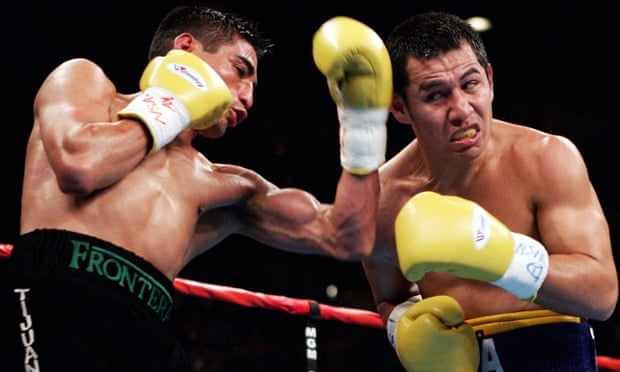
In the opening years of the 21st century, a mutual antipathy between two future Hall of Fame fighters festered and then flourished down Mexico way. As Marco Antonio Barrera and Erik Morales rose triumphantly through the weight divisions, so their dislike for one another appeared to increase exponentially.
Unusually for professional boxing, this shared enmity was both absolute and entirely genuine. Nothing was manufactured and media hyperbole was rendered redundant as the rivalry reached an intensity that is relatively, and mercifully, rare in a sport whose most prized goal is to temporarily relieve an opponent of their consciousness.
The most beautiful paradox of boxing is that the bonds forged and respect earned through mano-a-mano ringed conflict tend to douse any flames of hatred before they can fully consume either protagonist. Twelve three-minute rounds generally provide enough time to settle personal or professional differences and agree a bilateral truce, however fragile, uneasy or grudging that peace agreement may be. For Morales and Barrera, however, even 36 rounds of furious, gloved negotiations proved hopelessly inadequate. When the final chapter of their four-year fistic trilogy was complete, the two fighters still hated each other’s guts.
The genesis of the animosity is disputed to this day. Barrera, the older man by almost three years, turned professional at 15 and claimed the world super bantamweight title at a time when Morales, who didn’t fight professionally until the ripe old age of 16, was still knocking out unknowns in Baja California.
With the light of the iconic Julio Cesar Chavez’s star finally beginning to dim, heir apparent Barrera was looking forward to assuming the mantle of Mexico’s premier pugilistic hero. Morales’ emergence, coupled with a brace of chastening defeats to the American, Junior Jones, threatened this coronation and some believe the seeds of rancour were sown and germinated in the fertile soils of this mini career crisis.
For others, it was simply the inevitable result of the two boxers’ distinct backgrounds: an unavoidable class war with the added ****e of regional rivalry thrown in for good measure. Morales, the working-class street kid from the ******s of Tijuana, was never going to get along with Barrera, the educated, middle-class, big-city boy from El Distrito Federal, they say.
Whatever the spark that ignited the fire, both men played their full part in fanning the blaze. Months before their first encounter, an altercation at a football match in Mexico almost became physical. Barrera then referred to Morales using the racially sensitive term, Indio, while Morales was never slow to unleash personally insulting verbal volleys of his own in which neither mothers nor wives were off limits. Blows were exchanged before their second fight when Erik called Marco Antonio mariquita and later futile attempts at reconciliatory handshakes were met with flying water bottles.
Even more telling than these highly visible manifestations of the bad blood coursing through both fighters’ veins was the look in the eye when they met, and the tone of the voice when forced to speak of the other. Such body language cannot be faked: it had all become very, very personal. But if their behaviour outside the ring left a lot to be desired, it was impossible to fault them once inside the squared circle.
The first fight took place in the Mandalay Bay Hotel on 19 February 2000 and was immediately recognised for what it was: a standalone classic tear up. In starting off quick and aggressive and then getting faster and more furious, it set the tone for the trilogy. Ring Magazine crowned it Fight of the Year and the fifth round was awarded Round of the Year. At the end of 36 relentless minutes, Morales took a split-decision victory to add the WBO super bantamweight strap to the WBC belt he had won three years earlier.
Part two, 26 months later and one weight class up, moved a mile down Las Vegas Boulevard to the MGM Grand and is regarded as the most tactical of the three bouts. That may be so, but keep in mind that everything in life is relative. To suggest that either boxer performed quiescently is akin to describing Usain Bolt’s 9.72 second 100m in New York in 2008 as pedestrian compared to later runs in Beijing and Berlin. Make no mistake, Barrera-Morales II was again ferocious and this time Barrera received a unanimous nod to snatch the WBC featherweight belt from around his foe’s waist.
The aggregate score lay at one-all but the boxing world was certain that neither man would settle for a draw. All the ingredients for a classic finale were already in the pot but, just like the best slow-cooked tinga poblanas, it was set aside for an extended simmering period to allow all the competing flavours to infuse and intensify.
Over the next two years, Barrera beat stellar names such as Johnny Tapia, Kevin Kelley and Paulie Ayala, but lost to a young up-and-comer from the Philippines named Manny Pacquiao. Morales was even busier and a six-fight winning streak included the scalp of Jesus Chavez and a world title in a third weight class.
That WBC super featherweight title was on the line when Marco Antonio and Erik returned to the MGM Grand on 27 November 2004, but it was almost an aside. Legacies, pride, bragging rights and national standing in a country that holds their little fighting men in such high esteem was what made this conclusion so highly anticipated.
Morales, the younger and naturally bigger man, was the favourite going into the decider. This was Barrera’s first contest at 130lbs and when the opening bell rang, Morales was said to be 11lbs heavier than his opponent. To put that weight advantage into some perspective, only 10lbs separates flyweight from super bantamweight, with the super fly and bantamweight divisions in-between.
By Paul Gibson
In the opening years of the 21st century, a mutual antipathy between two future Hall of Fame fighters festered and then flourished down Mexico way. As Marco Antonio Barrera and Erik Morales rose triumphantly through the weight divisions, so their dislike for one another appeared to increase exponentially.
Unusually for professional boxing, this shared enmity was both absolute and entirely genuine. Nothing was manufactured and media hyperbole was rendered redundant as the rivalry reached an intensity that is relatively, and mercifully, rare in a sport whose most prized goal is to temporarily relieve an opponent of their consciousness.
The most beautiful paradox of boxing is that the bonds forged and respect earned through mano-a-mano ringed conflict tend to douse any flames of hatred before they can fully consume either protagonist. Twelve three-minute rounds generally provide enough time to settle personal or professional differences and agree a bilateral truce, however fragile, uneasy or grudging that peace agreement may be. For Morales and Barrera, however, even 36 rounds of furious, gloved negotiations proved hopelessly inadequate. When the final chapter of their four-year fistic trilogy was complete, the two fighters still hated each other’s guts.
The genesis of the animosity is disputed to this day. Barrera, the older man by almost three years, turned professional at 15 and claimed the world super bantamweight title at a time when Morales, who didn’t fight professionally until the ripe old age of 16, was still knocking out unknowns in Baja California.
With the light of the iconic Julio Cesar Chavez’s star finally beginning to dim, heir apparent Barrera was looking forward to assuming the mantle of Mexico’s premier pugilistic hero. Morales’ emergence, coupled with a brace of chastening defeats to the American, Junior Jones, threatened this coronation and some believe the seeds of rancour were sown and germinated in the fertile soils of this mini career crisis.
For others, it was simply the inevitable result of the two boxers’ distinct backgrounds: an unavoidable class war with the added ****e of regional rivalry thrown in for good measure. Morales, the working-class street kid from the ******s of Tijuana, was never going to get along with Barrera, the educated, middle-class, big-city boy from El Distrito Federal, they say.
Whatever the spark that ignited the fire, both men played their full part in fanning the blaze. Months before their first encounter, an altercation at a football match in Mexico almost became physical. Barrera then referred to Morales using the racially sensitive term, Indio, while Morales was never slow to unleash personally insulting verbal volleys of his own in which neither mothers nor wives were off limits. Blows were exchanged before their second fight when Erik called Marco Antonio mariquita and later futile attempts at reconciliatory handshakes were met with flying water bottles.
Even more telling than these highly visible manifestations of the bad blood coursing through both fighters’ veins was the look in the eye when they met, and the tone of the voice when forced to speak of the other. Such body language cannot be faked: it had all become very, very personal. But if their behaviour outside the ring left a lot to be desired, it was impossible to fault them once inside the squared circle.
The first fight took place in the Mandalay Bay Hotel on 19 February 2000 and was immediately recognised for what it was: a standalone classic tear up. In starting off quick and aggressive and then getting faster and more furious, it set the tone for the trilogy. Ring Magazine crowned it Fight of the Year and the fifth round was awarded Round of the Year. At the end of 36 relentless minutes, Morales took a split-decision victory to add the WBO super bantamweight strap to the WBC belt he had won three years earlier.
Part two, 26 months later and one weight class up, moved a mile down Las Vegas Boulevard to the MGM Grand and is regarded as the most tactical of the three bouts. That may be so, but keep in mind that everything in life is relative. To suggest that either boxer performed quiescently is akin to describing Usain Bolt’s 9.72 second 100m in New York in 2008 as pedestrian compared to later runs in Beijing and Berlin. Make no mistake, Barrera-Morales II was again ferocious and this time Barrera received a unanimous nod to snatch the WBC featherweight belt from around his foe’s waist.
The aggregate score lay at one-all but the boxing world was certain that neither man would settle for a draw. All the ingredients for a classic finale were already in the pot but, just like the best slow-cooked tinga poblanas, it was set aside for an extended simmering period to allow all the competing flavours to infuse and intensify.
Over the next two years, Barrera beat stellar names such as Johnny Tapia, Kevin Kelley and Paulie Ayala, but lost to a young up-and-comer from the Philippines named Manny Pacquiao. Morales was even busier and a six-fight winning streak included the scalp of Jesus Chavez and a world title in a third weight class.
That WBC super featherweight title was on the line when Marco Antonio and Erik returned to the MGM Grand on 27 November 2004, but it was almost an aside. Legacies, pride, bragging rights and national standing in a country that holds their little fighting men in such high esteem was what made this conclusion so highly anticipated.
Morales, the younger and naturally bigger man, was the favourite going into the decider. This was Barrera’s first contest at 130lbs and when the opening bell rang, Morales was said to be 11lbs heavier than his opponent. To put that weight advantage into some perspective, only 10lbs separates flyweight from super bantamweight, with the super fly and bantamweight divisions in-between.


Comment