

 Tweet
Tweet
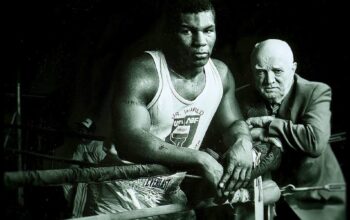
Cus D'Amato on how the recognition and acknowledgement of fear is the crucial lesson he taught and was ignored by other trainers:
“Fear is the greatest obstacle to learning in any area, but particularly in boxing. For example, boxing is something you learn through repetition. You do it over and over and suddenly you’ve got it. …However, in the course of trying to learn, if you get hit and get hurt, this makes you cautious, and when you’re cautious you can’t repeat it, and when you can’t repeat it, it’s going to delay the learning process…When they…come up to the gym and say I want to be a fighter, the first thing I’d do was talk to them about fear…I would always use…the same example of the deer crossing an open field and upon approaching the clearing suddenly instinct tells him danger is there, and nature begins the survival process, which involves the body releasing adrenalin into the bloodstream, causing the heart to beat faster and enabling the deer to perform extraordinarily feats of agility and strength…It enables the deer to get out of range of the danger, helps him escape to the safety of the forest across the clearing…an example in which fear is your friend.
The thing a kid in the street fears the most is to be called yellow or chicken, and sometimes a kid will do the most ******, wild, crazy things just to hide how scared he is. I often tell them that while fear is such an obnoxious thing, an embarrassing thing…nevertheless it is your friend, because anytime anyone saves your life perhaps a dozen times a day, no matter what how obnoxious he is, you’ve got to look upon him as a friend, and this is what fear is…Since nature gave us fear in order to help us survive, we cannot look upon it as an enemy. Just think how many times a day a person would die if he had no fear. He’d walk in front of cars, he’d die a dozen times a day. Fear is a protective mechanism….By talking to the fighters about fear I cut the learning time maybe as much as half, sometimes more, depending on the individual.”
....................
Source: *********
By Lisa Scott
4 November 2005
Often referred to as the Vince Lombardi of boxing, D'Amato achieved accolades for his work with Floyd Patterson (at the time, the youngest heavyweight champ at 21 years old after knocking out Archie Moore) and Jose Torres (who beat Willie Pastrano in 1965 for his light heavyweight title). However, D'Amato is best known as the savior of a 13 year old Brownsville, NY street hoodlum and creator of the most destructive fighter the heavyweight division has ever known - 'Iron' Mike Tyson; the youngest heavyweight to be crowned champ at the delicate age of 20.
Born Constantine D'Amato on January 17, 1908 in the tough Classon Point section of the Bronx in New York, he was one of eight children (all brothers) whose parents arrived in America from Italy in 1899. Raised during the Depression, in an all male environment (D'Amato's mother died when he was 4 yeas old), D'Amato wanted to be a boxer like his older brother Jerry. With his brother's gym bag slung over his shoulder, D'Amato would accompany him to the gym (St. Nicks' on 125th St.), absorbing as much knowledge as he could. But those dreams of becoming a professional prizefighter were derailed when at 12 years old, D'Amato engaged in a street fight with an adult man, which resulted in permanent blindness to D'Amato's left eye.
Nevertheless, D'Amato remained active in boxing and in 1939, co-founded the Gramercy Gym where he developed a stable of tough young boxers. One of them being Rocky Graziano, a fighter D'Amato developed as an amateur and expected to manage upon turning pro. However Graziano chose to enlist another manager, as well as a silent partner who reportedly had mob connections. The situation with Graziano was D'Amato's first taste of how bitter the sport could be and that 'stealing' fighters was a frequent and customary practice.
Incidentally, Gramercy Gym has since been torn down to make way for an appliance store. Yet in recognition of his achievements, the city of New York honored D'Amato after his death with a street sign (Cus D'Amato Way) at the gyms former location (14th street and Irving Place).
While D'Amato and his gym were gaining credibility, he was drafted into the Army in 1942. Upon his return to civilian life in 1945, D'Amato met Camille Ewald, a Ukrainian girl whose sister was married to D'Amato's older brother Rocco. Ewald became D'Amato's devoted and lifelong companion and eventually came to public attention as the woman who ran the huge house in Catskill and who Tyson lovingly referred to as his 'white mother.' Since D'Amato and Ewald never married and D'Amato never fathered children, they looked upon the young fighters living in their house as offspring. Especially Tyson, whom they both legally adopted when he was 15. At the age of 96, Ewald died in her sleep at home in 2001. She is buried next to D'Amato in a cemetery in Catskill.
After fighting for his country in WWII, the advent of another war was about to begin for D'Amato - a war with the International Boxing Club. For 11 years (1952-1963), D'Amato fought a dangerous battle against the IBC, an organization that gained strength in the late 1940's by monopolizing professional boxing within the United States. Fronted by a legitimate businessman (Jim Norris, a multi millionaire who owned the Detroit Red Wings, various stadiums and arenas as well as a substantial amount of stock in Madison Square Garden), the IBC was actually controlled by organized crime, namely by Frank 'Blinky' Palermo and Frankie Carbo (a member of Murder, Inc., and a mobster who achieved widespread notoriety as the underworld's 'Commissioner of Boxing'). One example of the deviance committed by the IBC occurred in 1947, when Jake LaMotta was forced to take a dive against Billy Fox in order to get a shot at the middleweight title. LaMotta eventually got that shot two years later (against Marcel Cerdan 1949).
By controlling the fighters and titles, the IBC was able to reap tremendous benefits, especially when it came to the prestigious heavyweight title. Thus, when D'Amato led Patterson to the heavyweight championship in 1956, D'Amato refused to deal with promoters affiliated with the IBC. Having 'The Champ' (whom the public wanted to see) enabled him to call the shots and work with legitimate promoters. It was a bold and daring stance in an environment wrought with collusion and chicanery. But D'Amato's tenaciousness paid off and Patterson became the first fighter to earn a million dollar purse. Eventually, the IBC was investigated by the Senate (Estes) Keefauver Committee and the extent of the corruption was revealed. The IBC was ruled a monopoly and forced to disband, and Carbo was jailed for 25 years.
Soon after, D'Amato found his way to Rhinebeck, NY to train heavyweight Buster Mathis. When his association with Mathis ended, D'Amato sold his Gramercy Gym for $1 (yes, 1 dollar) to trainers Bob Jackson and Al Gavin (the famed cut man who is recently deceased), and moved to the economically depressed town of Catskill where he opened the Catskill Boxing Club above a police station on Main St., in 1970. Because the IBC was reputed to have mob connections, and some of the 'people' that were 'involved' were still around... D'Amato chose to leave NYC. Of his decision, D'Amato was quoted as saying: "I wasn't paranoid. I just assumed that they would hurt me if they could, and I acted accordingly."
Ewald and D'Amato then bought an old 2 story, 13 room Victorian mansion. The house is a few miles away from the gym and is situated on the beautifully scenic Hudson River and located off a clandestine road where it's secretly tucked away at the end of a treacherously long, narrow and winding dirt path. After Ewald's death, the house was sold to a lawyer from NYC.
D'Amato's intentions were simple - to help troubled and underprivileged kids straighten out their lives through boxing. Among them was 19 year old Kevin Rooney, a 1975 NY Golden Gloves champ and product of a broken, alcoholic home in Staten Island. Rooney became a loyal and dedicated student of D'Amato - who (after his death) passed the torch on to Rooney and who later led Tyson to a championship. To this day, Rooney operates the Catskill Boxing Club and carries on the D'Amato tradition of training anyone who steps through the gym doors... for free.
.
“Fear is the greatest obstacle to learning in any area, but particularly in boxing. For example, boxing is something you learn through repetition. You do it over and over and suddenly you’ve got it. …However, in the course of trying to learn, if you get hit and get hurt, this makes you cautious, and when you’re cautious you can’t repeat it, and when you can’t repeat it, it’s going to delay the learning process…When they…come up to the gym and say I want to be a fighter, the first thing I’d do was talk to them about fear…I would always use…the same example of the deer crossing an open field and upon approaching the clearing suddenly instinct tells him danger is there, and nature begins the survival process, which involves the body releasing adrenalin into the bloodstream, causing the heart to beat faster and enabling the deer to perform extraordinarily feats of agility and strength…It enables the deer to get out of range of the danger, helps him escape to the safety of the forest across the clearing…an example in which fear is your friend.
The thing a kid in the street fears the most is to be called yellow or chicken, and sometimes a kid will do the most ******, wild, crazy things just to hide how scared he is. I often tell them that while fear is such an obnoxious thing, an embarrassing thing…nevertheless it is your friend, because anytime anyone saves your life perhaps a dozen times a day, no matter what how obnoxious he is, you’ve got to look upon him as a friend, and this is what fear is…Since nature gave us fear in order to help us survive, we cannot look upon it as an enemy. Just think how many times a day a person would die if he had no fear. He’d walk in front of cars, he’d die a dozen times a day. Fear is a protective mechanism….By talking to the fighters about fear I cut the learning time maybe as much as half, sometimes more, depending on the individual.”
....................
Source: *********
By Lisa Scott
4 November 2005
Often referred to as the Vince Lombardi of boxing, D'Amato achieved accolades for his work with Floyd Patterson (at the time, the youngest heavyweight champ at 21 years old after knocking out Archie Moore) and Jose Torres (who beat Willie Pastrano in 1965 for his light heavyweight title). However, D'Amato is best known as the savior of a 13 year old Brownsville, NY street hoodlum and creator of the most destructive fighter the heavyweight division has ever known - 'Iron' Mike Tyson; the youngest heavyweight to be crowned champ at the delicate age of 20.
Born Constantine D'Amato on January 17, 1908 in the tough Classon Point section of the Bronx in New York, he was one of eight children (all brothers) whose parents arrived in America from Italy in 1899. Raised during the Depression, in an all male environment (D'Amato's mother died when he was 4 yeas old), D'Amato wanted to be a boxer like his older brother Jerry. With his brother's gym bag slung over his shoulder, D'Amato would accompany him to the gym (St. Nicks' on 125th St.), absorbing as much knowledge as he could. But those dreams of becoming a professional prizefighter were derailed when at 12 years old, D'Amato engaged in a street fight with an adult man, which resulted in permanent blindness to D'Amato's left eye.
Nevertheless, D'Amato remained active in boxing and in 1939, co-founded the Gramercy Gym where he developed a stable of tough young boxers. One of them being Rocky Graziano, a fighter D'Amato developed as an amateur and expected to manage upon turning pro. However Graziano chose to enlist another manager, as well as a silent partner who reportedly had mob connections. The situation with Graziano was D'Amato's first taste of how bitter the sport could be and that 'stealing' fighters was a frequent and customary practice.
Incidentally, Gramercy Gym has since been torn down to make way for an appliance store. Yet in recognition of his achievements, the city of New York honored D'Amato after his death with a street sign (Cus D'Amato Way) at the gyms former location (14th street and Irving Place).
While D'Amato and his gym were gaining credibility, he was drafted into the Army in 1942. Upon his return to civilian life in 1945, D'Amato met Camille Ewald, a Ukrainian girl whose sister was married to D'Amato's older brother Rocco. Ewald became D'Amato's devoted and lifelong companion and eventually came to public attention as the woman who ran the huge house in Catskill and who Tyson lovingly referred to as his 'white mother.' Since D'Amato and Ewald never married and D'Amato never fathered children, they looked upon the young fighters living in their house as offspring. Especially Tyson, whom they both legally adopted when he was 15. At the age of 96, Ewald died in her sleep at home in 2001. She is buried next to D'Amato in a cemetery in Catskill.
After fighting for his country in WWII, the advent of another war was about to begin for D'Amato - a war with the International Boxing Club. For 11 years (1952-1963), D'Amato fought a dangerous battle against the IBC, an organization that gained strength in the late 1940's by monopolizing professional boxing within the United States. Fronted by a legitimate businessman (Jim Norris, a multi millionaire who owned the Detroit Red Wings, various stadiums and arenas as well as a substantial amount of stock in Madison Square Garden), the IBC was actually controlled by organized crime, namely by Frank 'Blinky' Palermo and Frankie Carbo (a member of Murder, Inc., and a mobster who achieved widespread notoriety as the underworld's 'Commissioner of Boxing'). One example of the deviance committed by the IBC occurred in 1947, when Jake LaMotta was forced to take a dive against Billy Fox in order to get a shot at the middleweight title. LaMotta eventually got that shot two years later (against Marcel Cerdan 1949).
By controlling the fighters and titles, the IBC was able to reap tremendous benefits, especially when it came to the prestigious heavyweight title. Thus, when D'Amato led Patterson to the heavyweight championship in 1956, D'Amato refused to deal with promoters affiliated with the IBC. Having 'The Champ' (whom the public wanted to see) enabled him to call the shots and work with legitimate promoters. It was a bold and daring stance in an environment wrought with collusion and chicanery. But D'Amato's tenaciousness paid off and Patterson became the first fighter to earn a million dollar purse. Eventually, the IBC was investigated by the Senate (Estes) Keefauver Committee and the extent of the corruption was revealed. The IBC was ruled a monopoly and forced to disband, and Carbo was jailed for 25 years.
Soon after, D'Amato found his way to Rhinebeck, NY to train heavyweight Buster Mathis. When his association with Mathis ended, D'Amato sold his Gramercy Gym for $1 (yes, 1 dollar) to trainers Bob Jackson and Al Gavin (the famed cut man who is recently deceased), and moved to the economically depressed town of Catskill where he opened the Catskill Boxing Club above a police station on Main St., in 1970. Because the IBC was reputed to have mob connections, and some of the 'people' that were 'involved' were still around... D'Amato chose to leave NYC. Of his decision, D'Amato was quoted as saying: "I wasn't paranoid. I just assumed that they would hurt me if they could, and I acted accordingly."
Ewald and D'Amato then bought an old 2 story, 13 room Victorian mansion. The house is a few miles away from the gym and is situated on the beautifully scenic Hudson River and located off a clandestine road where it's secretly tucked away at the end of a treacherously long, narrow and winding dirt path. After Ewald's death, the house was sold to a lawyer from NYC.
D'Amato's intentions were simple - to help troubled and underprivileged kids straighten out their lives through boxing. Among them was 19 year old Kevin Rooney, a 1975 NY Golden Gloves champ and product of a broken, alcoholic home in Staten Island. Rooney became a loyal and dedicated student of D'Amato - who (after his death) passed the torch on to Rooney and who later led Tyson to a championship. To this day, Rooney operates the Catskill Boxing Club and carries on the D'Amato tradition of training anyone who steps through the gym doors... for free.
.


Comment