
Boxing News
 Lemino BOXING PR事務局/Matchroom/Golden Boy
Provided that the AI apocalypse doesn’t come to pass in the next three months, we will complete the calendar year 2026.
And there have been thousands of boxers who have spent parts of this calendar year fighting in exchange for prize money.
So we will have a year. And we have had fighters.
But does that mean we’re required to have a Fighter of the Year?
It’s not something I’ve ever wondered about before. But in 2026, unless something unexpected gets added to the schedule between now and December 31, there may not be a realistic path to a male boxer finishing the year having done enough to feel deserving of the award. The boxing media will simply find itself voting for the least bad option.
Often around this time of year, boxing columnists and analysts pause to handicap the Fighter of the Year race, and the list of contenders typically includes one or two guys who’ve scored career-defining wins and another few fighters with multiple high-quality performances under their belt. Plus it usually includes a couple of superstars set to clash head-to-head in November or December who haven’t had stand-out years yet, but, boy, if either of them whips the other in style, he’ll have to be in the mix.
In 2026, as we roll into October, there’s none of that.
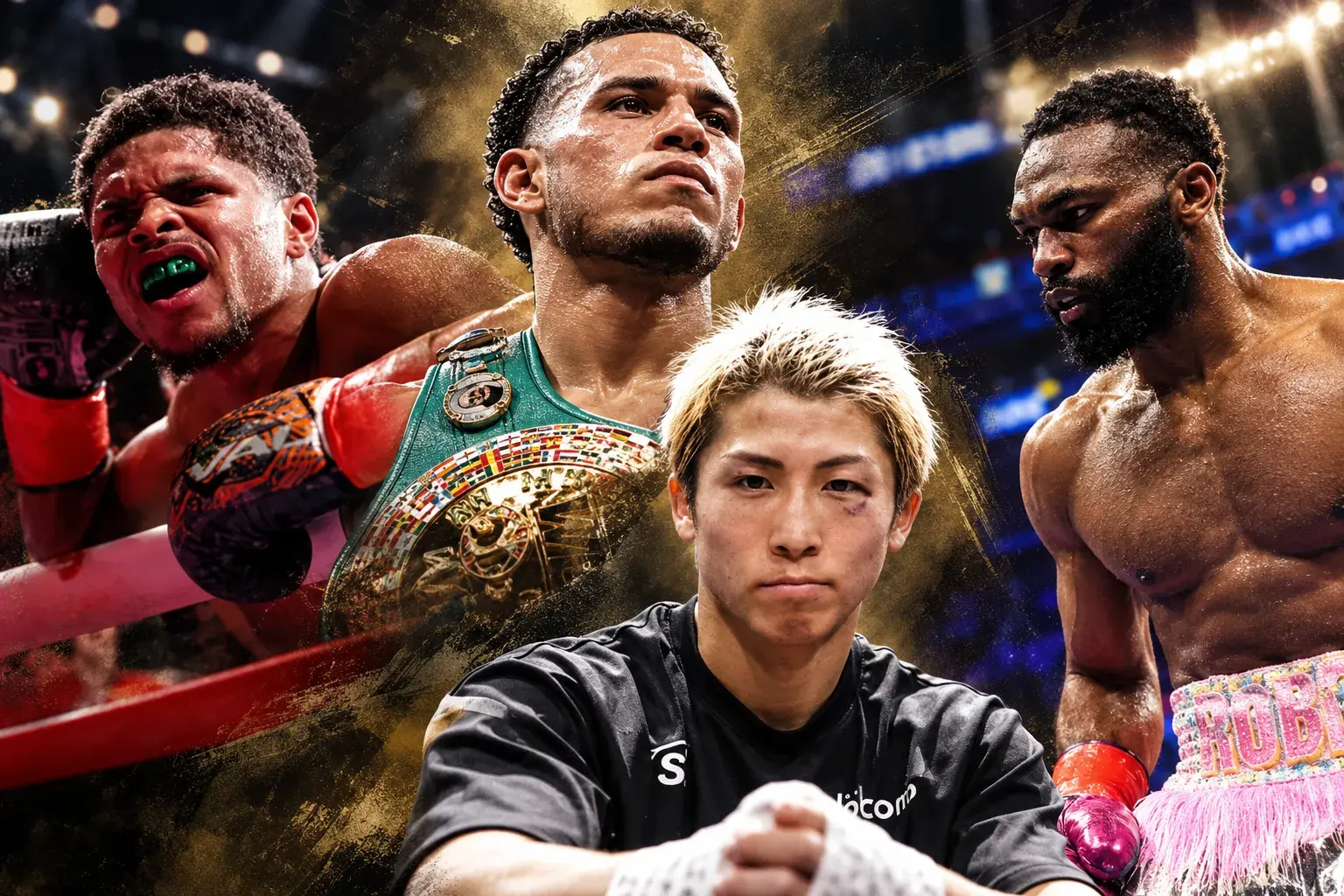
The way I see it, there are four pound-for-pound-level fighters who have scored one very good but not quite career-defining win apiece, but none of them have fought a second time and it’s unclear whether any of them will; one superstar with two moderately impressive victories under his belt but nothing else scheduled; and one bout coming up between A-minus-level guys that could vault the winner into the conversation — but only because the conversation is so desperate for someone, anyone to do some vaulting.
Here's specifically who I’m talking about:
Naoya Inoue: Most people’s pound-for-pound king and probably the frontrunner for Fighter of the Year at the moment because, well, how much crap can you give someone for voting for Inoue? Inoue defeated Junto Nakatani, an undefeated, highly respected fighter who was not seen as a massive underdog. And Inoue performed … roughly to expectations? Sufficiently? With skill and class? Describe it how you like, Inoue won a close, deserved decision, more or less as he was supposed to, in a high-pedigree prizefight that nobody will be telling their grandkids about. And that’s it. That’s his 2026. He boxed once and he won’t box again. If he were set to take on Jesse “Bam” Rodriguez before the calendar turns over, this would be easy. But he’s not, and it isn’t.
Shakur Stevenson: Fighter of the Year was there for the taking for Stevenson when, with 11 full months remaining in 2026, he moved up in weight and boxed brilliantly and, as about a 3-to-1 favorite, defeated the undeniably talented (if inconsistent) Teofimo Lopez by scores of 119-109 on all three scorecards to claim the lineal junior welterweight title. All he had to do was score a second win half as meaningful as that one and he’d be a lock for the award. Even if he fought a second time against some jobber from parts unknown, that would be enough in a down year like this. But between February 1 and this article’s publication date, Stevenson has not fought, and the closest he’s come is a quickly debunked rumor about him facing Manny Pacquiao (an atrocity that would likely have hurt his Fighter of the Year case). In recent days, talk of Shakur lining up Gary Antuanne Russell has burbled to the surface. If it happens by the end of December, FOTY could become very straight-forward. But at the pace at which things move in boxing nowadays, it seems a longshot that early-October burbling will spawn December battling — especially when it requires a Russell brother to fight a second time in a single year, which goes directly against the code of conduct formally outlined in the Russell family by-laws.
David Benavidez: Gilberto “Zurdo” Ramirez is nobody’s idea of a future Hall of Famer, but in May, on the same day “Monster” Inoue outpointed Nakatani, “The Mexican Monster” moved up from light heavyweight to cruiserweight and eviscerated Ramirez in six brutal rounds. It was a dazzling, destructive win. Alongside Inoue and Stevenson, Benavidez was a top candidate for Fighter of the Half-Year. But — you should be sensing a pattern by now — Benavidez hasn’t fought again and may or may not fight again before we’re singing “Auld Lang Syne.” And if he does fight in December, it would be against relatively anonymous Michael Cieslak. Which is better than not fighting at all … I guess?
Jaron “Boots” Ennis: On June 27, just before we hit the midpoint of the year, Boots stopped fellow up-and-comer Xander Zayas in the seventh round of a thriller. Zayas is a level below a Nakatani or a Teofimo, and Ennis’ dominance was nowhere near as pronounced as Stevenson’s or Benavidez’s. In other words, he was in fourth place out of the foursome listed thus far. But if none of the other three were going to fight a second time and Ennis was, he could’ve advanced to first place out of four. Alas, he hasn’t fought again, and it’s a tossup whether his planned bout against Josh Kelly will be scheduled for December or January. If it’s the former, well, wins over Zayas and Kelly aren’t exactly on par with, say, Pacquiao stopping by Ricky Hatton and Miguel Cotto in 2009, but those two victories might be enough in 2026.
Ryan Garcia: Wait a minute, what do we have here? A star fighter who has already competed twice in 2026? In the 1930s, Henry Armstrong used to call that level of activity “September.” But times have changed (a lot), and to Garcia’s credit, he not only fought twice, but he won twice and looked outstanding twice — and in two different ways. He showed a little bit of everything in dropping Mario Barrios in the opening round and outboxing him over the 12-round distance, then he flashed his power and took care of Conor Benn inside a round and a half. The problem? Barrios was your run-of-the-mill beltholder everyone cherry-picks against, and Benn would be little more than a mid-carder if his name was Conor Blumstein. Opinions vary as to whether Garcia turned a corner this year or his matchmaker did.
The Emanuel Navarrete-O’Shaquie Foster winner: Navarrete has one fairly strong win on his resume this year, an 11th-round TKO over Eduardo Nunez in a 50-50-ish fight coming in. So does Foster, winning a deserved majority decision as a modest favorite over Raymond Ford. They’re squaring off in three weeks, and it could stand as a career-best win for the victor (especially if that victor is Foster). Whoever prevails — as long as it isn’t controversial and the fight isn’t a stinker — probably moves ahead of Garcia in the ranks of boxers with two quality wins in 2026.
I’ve lived through some crummy years trying to determine the FOTY before. 1999 stands out in particular. Felix Trinidad defeated both Pernell Whitaker and Oscar De La Hoya, but the latter required some generosity from the judges on top of a strategic blunder from the opponent. Lennox Lewis unified the heavyweight crowd by going 1-0-1 against Evander Holyfield, but their two fights were remembered more for a Eugenia Williams scorecard than for anything that transpired inside the ropes. And Paulie Ayala scored a close, deserved, thrilling upset win over Johnny Tapia in one of his three fights that year, but the other two were against anonymous non-contenders.
Nobody among the Ayala-Trinidad-Lewis trio made for a wholly satisfying option.
But I’d take any of them over whoever ends up getting the award in 2026.
I was an editor at The Ring magazine in ’99, and after much debate, we went with Ayala. The Texas bantamweight’s win over unbeaten future Hall of Famer Tapia was somewhere in the same ballpark for merit as Inoue’s over Nakatani. As a key point of comparison to Inoue’s 2026, however, I doubt we would have given Ayala the award 27 years ago if all he had was the Tapia fight. The rest of his resume wasn’t much — one tune-up before Tapia and one soft title defense after Tapia — but at least there was a “rest of his resume” to consider.
And it’s not that I’m a hardliner against giving Fighter of the Year honors to somebody who only stepped into the ring once. It’s just that I need that one victory to be extraordinary.
Think Crawford last year, moving up two divisions and soundly outfighting super-duper-star Saul “Canelo” Alvarez. I also would have been fine with Crawford winning in 2023, when he demolished Errol Spence.
Some considered George Foreman the Fighter of the Year in 1994, when he only fought once. That’s reasonable, considering that, in that lone fight, he became lineal heavyweight champion at age 45.
Marvelous Marvin Hagler was a co-winner of The Ring’s award in ’85, when he only fought once. In fact, he only fought for eight minutes that year. And if you know anything about boxing, you know what mentioning “Hagler” and “eight minutes” in the same sentence means.
So, yes, on occasion, one fight in a calendar year is enough. But that one fight ought to feature the sort of performance we’ll still be talking about a couple of decades later. And somehow I don’t think that label applies to Inoue-Nakatani, Stevenson-Lopez, Benavidez-Ramirez or Ennis-Zayas.
In any other year, I wouldn’t even pause to consider whether Daniel Dubois gets into the conversation if he beats Fabio Wardley a second time. But this year, well, I guess I just kinda paused to consider it, didn’t I?
Not even the late Dr. Harold Bornstein could declare the sport of boxing healthy right now, and the infrequency with which the top fighters compete is a big part of the reason. If the sport can’t deliver for the fans, and the athletes can’t be bothered to grab their lunchpails and go to work more than once, then who says we need to reward someone with a Fighter of the Year award?
Naming a Fighter of the Year for 2026 is akin to crowning an “email champion.” I say unless or until someone earns the title in the ring, the fair thing to do is to leave the title vacant.
Eric Raskin is a veteran boxing journalist with nearly 30 years of experience covering the sport for such outlets as BoxingScene, The Good Fight, ESPN, Grantland, Playboy, and The Ring (where he served as managing editor for seven years). He also co-hosted The HBO Boxing Podcast, Showtime Boxing with Raskin & Mulvaney, The Interim Champion Boxing Podcast with Raskin & Mulvaney, and Ring Theory. He has won four first-place writing awards from the BWAA, for his work with The Ring, Grantland, HBO, and BoxingScene. Outside boxing, he is the senior editor of CasinoReports and the author of 2014’s The Moneymaker Effect. He can be reached on X, BlueSky, or LinkedIn, or via email at RaskinBoxing@yahoo.com.