Tyson Fury reveals schizophrenia diagnosis during darkest period of his career
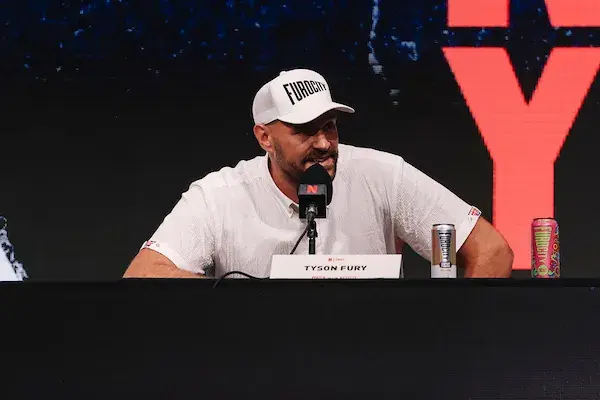 Zachariah Delgado/Matchroom
Tyson Fury has revealed further details about the mental health problems that threatened to end his boxing career following his victory over Wladimir Klitschko in 2015.
In a new Netflix documentary, the 38-year-old reveals that he was diagnosed with schizophrenia and bipolar disorder in 2016, during a period in which he struggled with addiction, gained considerable weight, and relinquished the world heavyweight titles he had won from Klitschko.
Fury's condition deteriorated to the point that he began hearing voices, including threats against himself and his family. He also experienced delusions, at one stage believing that messages were being directed at him through the radio.
The situation came to a head in June 2016 when he was admitted to hospital with a suspected heart attack. Doctors determined that he had suffered an anxiety attack, and subsequent psychiatric assessments resulted in diagnoses of schizophrenia and bipolar disorder.
Fury's problems extended beyond his mental health. In 2016, it emerged that he and cousin Hughie had returned adverse findings for the banned anabolic steroid nandrolone following tests conducted in February 2015, nine months before Tyson defeated Klitschko.
Fury also tested positive for cocaine in September 2016, during preparations for a rematch with Klitschko that would never take place.
Having already been stripped of the IBF title in December 2015 for agreeing to that rematch, Fury relinquished his remaining WBA and WBO belts in October 2016, shortly before the British Boxing Board of Control suspended his licence.
The nandrolone case was eventually settled in December 2017, with Fury accepting a backdated two-year ban while maintaining that he had never knowingly taken a prohibited substance.
'A living version of the pits of hell'
"Words can't explain the darkness I was in," Fury says in the documentary.
"It was like a living version of the pits of hell. I thought I would end up in a padded room with the door locked, and that scared me so much."
Fury, who had become one of the most recognizable figures in boxing after ending Klitschko's long reign, found himself unable to cope with everyday life.
"I wouldn't be able to sit and have a conversation because I'd be hearing stuff in my mind," he recalls.
"I didn't know where to turn and no-one knew what to do. I really needed help, or check into rehab or something."
It would be more than a year before Fury began to turn his life around. He identifies a Halloween party in 2017 as the moment he realized how far he had fallen, having become increasingly dependent on alcohol and deeply unhappy with his physical appearance.
The realization prompted a return to training and, eventually, a remarkable comeback. Fury resumed his professional career in June 2018 and, less than two years later, stopped WBC titlist Deontay Wilder in their rematch to become heavyweight champion for a second time.
Fury is preparing for another defining occasion when he faces Anthony Joshua in Cardiff on December 11. The long-awaited all-British showdown will be broadcast by Netflix, which is also releasing the documentary detailing Fury's struggles on Friday.