Ryan Garcia is the perfect avatar for Zuffa Boxing (even if he’s not theirs… yet)

Sep 14, 2026 • 6:09 AM ET
 Zuffa Boxing
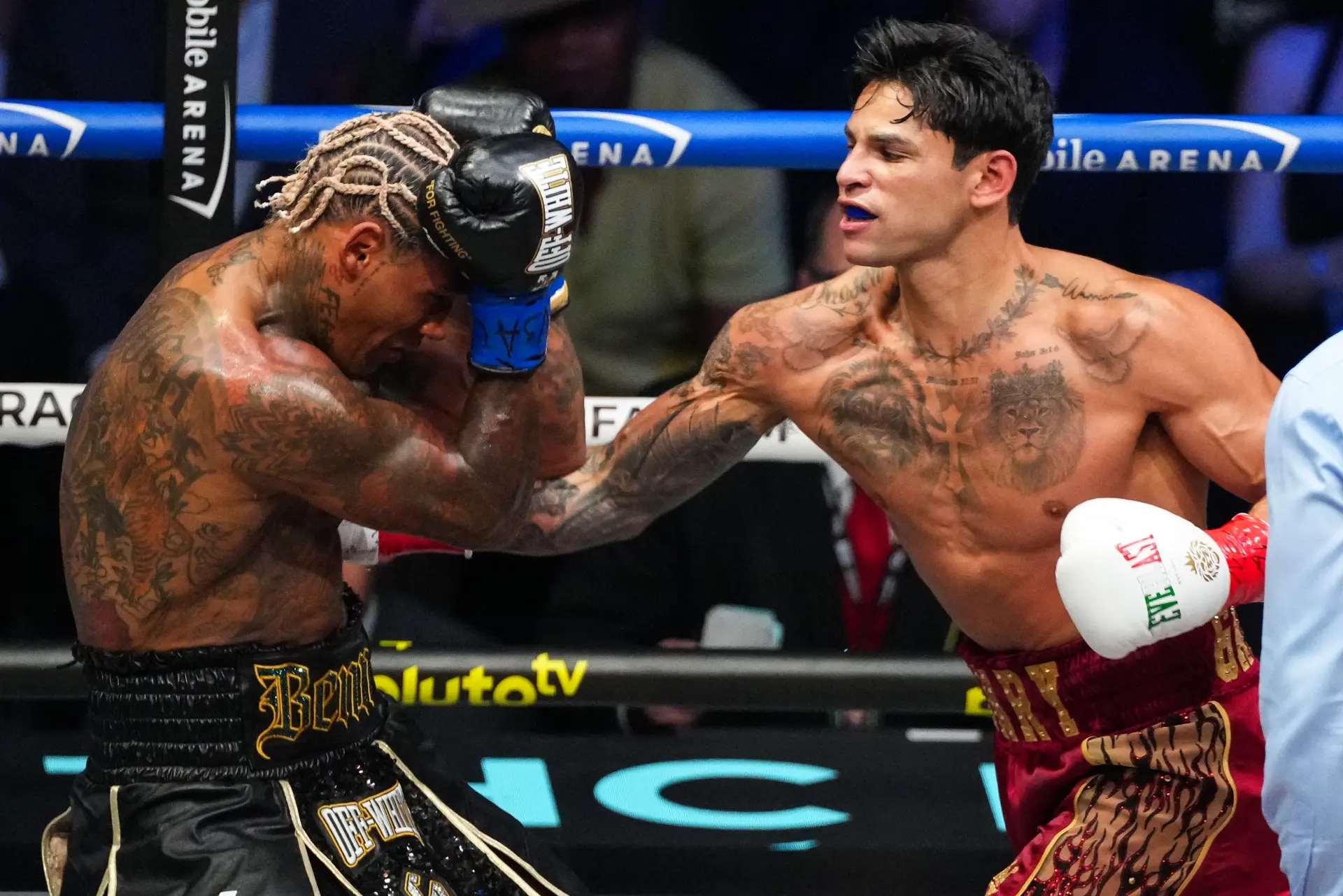
What we saw Saturday night was either a dazzling, destructive display from the next crossover superstar who will carry American boxing or a meaningless mismatch against a tailor-made and overpaid fraud — with no in between.
In reality, of course, there is a vast in-between.
But in the social media sphere and the on-air one-upmanship to see who can shout the loudest, you have to pick a side: Either Ryan Garcia finished it in the second round because he is the second coming, or Conor Benn is a second-class fighter who was only invited because of his second-generation status.
We all know in our rational brains that there is a degree of truth in both, but it’s tempting to get caught up in the moment and envision the highest-upside scenario, in which the handsome, heavy-handed, athletic, charismatic Garcia is boxing’s savior. And on that front, he has much in common with the promoter of Saturday’s event at T-Mobile Arena in Las Vegas. Zuffa Boxing could be, in its highest-upside scenario, everything boxing fans have been dreaming of for decades. Or it could be whatever the promotional equivalent is of a boxer as talented as Garcia finding a way to lose to Rolly Romero.
The inconsistency and the range of possibilities are what make Garcia so fascinating. He could end up in the International Boxing Hall of Fame. Or he could end up his generation’s ultimate woulda-coulda-shoulda. (Or, as Hector Camacho Snr demonstrated, he could do both.)
Eviscerating son-of-a-Hall-of-Famer Benn in four minutes and 25 seconds certainly doesn’t hurt “KingRy’s” Hall of Fame case. But at the same time, it didn’t prove much or tell us anything we didn’t already know, except maybe that his right hand is coming along as a weapon.
Along the same lines, Zuffa put on an entertaining four-fight main card in its most high-profile boxing event to date, reportedly selling out T-Mobile to the tune of 18,855 attendees and a live gate of a shade over $8 million. But perhaps that’s also merely meeting the obvious expectations when you spend what they (or their Saudi Arabian backers) spend on the purses for and the marketing of this event.
As reported last Tuesday in the JohnWallStreet sports business newsletter, the buildup included fighter appearances on The Tonight Show, First Take, The Pat McAfee Show, Logan Paul’s Impaulsive, Shannon Sharpe’sClub Shay Shay and All the Smoke, and the Garcia-Benn bout got promotional pushes on UFC broadcasts and socials, on WWE broadcasts and socials and at Fanatics Fest. Also, the main event cost a reported $30 million in combined purses, believed to be split about evenly, which would make this Benn’s second straight $15 million-ish payday, after Zuffa reportedly paid him that same exorbitant amount for an undercard bout in April against badly faded Regis Prograis.
For all that, in terms of viewership, Crakes Media founder Patrick Crakes told Corey Leff (the writer behind JohnWallStreet), “A reasonable minimum performance benchmark for Garcia–Benn is a global Live+1 average-minute audience of at least 8 million viewers for the main event. Averaging 10 million would represent a clear success, while averaging 20 million would be a massive result.”
It will be interesting to see where on that spectrum the broadcast lands and whether Paramount+ got the desired audience bang for Zuffa’s assorted bucks.
Wherever that number ends up, it’s not just about one fight card for Zuffa, or even one year of fight cards. Max Kellerman, who is both one of boxing’s most knowledgeable current historians/analysts and a broadcaster who is on the Zuffa payroll — in other words, mileage on his takes will vary — summed up the big-picture upside with Zuffa on the September 4 episode of his podcast, Game Over.
“The issue with boxing has always been that there’s no ‘they’ there,” Kellerman began. “Because there’s no ‘they’ there in boxing, there’s no central authority making long-term plans in boxing, no one knows the characters. … It’s all one-offs and short-term — you know, let’s bilk the public for everything we can for this one pay-per-view. And there’s no long-term plan. If I were to say, ‘you know what ‘they’ should do in football?’ you know I mean the NFL. There’s no NFL in boxing.
“The reason I’m in Zuffa Boxing is because I felt for the first time ever, when Dana and Nick — when Dana White and Nick Khan called me, I felt like, for the first time ever, there’s a chance to have a ‘they’ in boxing — over the next five years or whatever, to build this thing up to where there’s an NFL or NBA in boxing.”
If you prefer to see the same concept expressed in mind-numbing corporate-speak that reads like an AI-generated LinkedIn post, the JohnWallStreet newsletter quoted Fanatics Chief Strategy and Growth Officer Tucker Kain explaining Zuffa’s efforts to “galvanize the sport into a more holistic organized property [with a bit more consistency and reliability], where we can plan [and] innovate together, [enables us to] scale [together and do] some of the things that Fanatics does best.”
The potential for Zuffa to transform the sport of boxing for the better, to reverse its momentum with regard to the mainstream and stem the tide of audience shrinkage, is undeniable and alluring.
Equally undeniable, and not at all alluring, is the downside.
We all know Zuffa (or TKO or Sela or whoever is the correct parent company or sub-company to cite for a given development) has been working its political connections in an effort to revise the Muhammad Ali Boxing Reform Act of 2000. The publicly stated opposition — from the likes of active fighter Nico Ali Walsh, retired fighter Evander Holyfield and active promoter/retired fighter Oscar De La Hoya — includes concerns over greatly reduced financial transparency for fighters and the greasing of the skids toward something akin to a monopoly, at least in America, for Zuffa.
As Kellerman said, the sport of boxing could absolutely benefit from the presence of a “they.” At the same time, you don’t have to rack your brain too hard to come up with real-world examples of how things go wrong when self-interested people acquire too much power and remove too many guardrails.
Also, it’s worth asking: What happens if the Saudi investment in boxing goes away? That’s a question lots of folks owed money by the LIV Golf tour have been asking lately.
Zuffa’s financial investment in Benn went about as well as the Cleveland Browns’ in Deshaun Watson. Then again, that investment in Benn may work out brilliantly if it was designed as a loss leader to get into the Ryan Garcia business.
Saturday’s fight was every bit the mismatch most expected it to be, and some corners of social media reacted as such. Boxing writer Ryan Songalia tweeted, “They gave Conor Benn infinity moneys to make Ryan Garcia look like Tommy Hearns,” while Hall of Fame former network executive and promoter Lou DiBella posted, “Easiest money ever. One less bogus ‘star’ in #boxing. Thanks, Ryan.”
Garcia still has one fight remaining on his contract with Golden Boy Promotions, and maybe that will mark the end of his tumultuous relationship with Oscar De La Hoya. The latest gossip-rag-worthy development saw Garcia claim Oscar no-showed his ring walk for the Benn fight, to which Golden Boy Director of Communications Jane Murcia responded that, on the morning of the fight, “we received a call from Ryan’s team informing us that Ryan had changed his mind and no longer wanted ODLH to walk him out.”
King Henry VIII and Anne Boleyn had nothing on KingRy and Oscar.
One assumes Garcia will split with Golden Boy as soon as he is legally able, and Zuffa will then move in and aim to build a Cinco de Mayo 2027 card around him. But there is danger in assuming anything about what will happen next with De La Hoya and Garcia. And there is danger in assuming Garcia will be as red hot after his next fight as he appears to be right now.
His ups and downs the last three-plus years have been jarring. In his first huge PPV fight, in April 2023, Garcia got stopped by Gervonta Davis on a body shot. (Imagine the odds you could have gotten at that moment on Garcia being the potential face of boxing in 2026 and “Tank” being borderline irrelevant.) Garcia appeared to score a career-best upset win over Devin Haney a year later, only to have it turned into a no-contest due to failed PED tests. A year after that, he somehow became the first and last championship-level fighter the limited Romero ever defeated. He has since dominated Mario Barrios and Benn in two very different manners, suggesting that perhaps he’s matured as a fighter and turned a corner and stabilized at age 28 … or perhaps just indicating that he’s been matched well for two whole fights in a row.
Garcia-Benn was the brief but explosive capper to a balanced and undeniably entertaining Zuffa card. We got a competitive 10-round scrap between lightweight contenders Andres Cortes and Mark Magsayo, a dramatic one-armed first-round knockout by heavyweight prospect Da’Mazion Vanhouter, a compelling lineal cruiserweight championship defense by Jai Opetaia against a game Noel Mikaelian and a round-and-a-half of Garcia-Benn.
We also got a faceoff between Opetaia and David Benavidez and a near-faceoff (thwarted by apparently underinformed ringside security personnel) between Garcia and Teofimo Lopez.
It was a strong show, save for one egregious entertainment failing: The main broadcast was scheduled to begin at 5 p.m. local time in Vegas and the first ring walk didn’t commence until 5:40, the result of the Paramount+ producers apparently believing the audience would rather listen to an eight-person podcast than watch a fight. Though Dana White has been an outspoken critic of wasted time on boxing telecasts, it didn’t take him long to become part of the problem.
That aside, once the actual fights began, this card was mostly a showcase for the appeal of boxing. And it gave Zuffa something to build on — maybe all the way to a Garcia-Lopez, Opetaia-Benavidez doubleheader on the Vegas Strip next May.
Zuffa Boxing has entered the sport with hype and hope and promise and is delivering on a lot of it — while also possessing the potential to implode, cause more problems than it solves, piss people off and eventually go the way of so many flash-in-the-pan “disruptors” we’ve encountered over the years.
All of which doubles for an apt description of the fighter who decimated Zuffa’s $30 million man over the weekend.
Zuffa and Garcia make a lot of sense together. Maybe the former will be boxing’s “they” and the latter boxing’s next “he.”
Whether apart or together, both have the potential to leave serious destruction in their wake.
Eric Raskin is a veteran boxing journalist with nearly 30 years of experience covering the sport for such outlets as BoxingScene, The Good Fight, ESPN, Grantland, Playboy, and The Ring (where he served as managing editor for seven years). He also co-hosted The HBO Boxing Podcast, Showtime Boxing with Raskin & Mulvaney, The Interim Champion Boxing Podcast with Raskin & Mulvaney, and Ring Theory. He has won four first-place writing awards from the BWAA, for his work with The Ring, Grantland, HBO, and BoxingScene. Outside boxing, he is the senior editor of CasinoReports and the author of 2014’s The Moneymaker Effect. He can be reached on X, BlueSky, or LinkedIn, or via email at RaskinBoxing@yahoo.com.

Eric Raskin is a veteran boxing journalist with nearly 30 years of experience covering the sport for such outlets as BoxingScene, The Good Fight, ESPN, Grantland, Playboy, and The Ring (where he served as managing editor for seven years). He also co-hosted The HBO Boxing Podcast, Showtime Boxing with Raskin & Mulvaney, The Interim Champion Boxing Podcast with Raskin & Mulvaney, and Ring Theory. He has won four first-place writing awards from the BWAA, for his work with The Ring, Grantland, HBO, and BoxingScene. Outside boxing, he is the senior editor of CasinoReports and the author of 2014’s The Moneymaker Effect. He can be reached on X, BlueSky, or LinkedIn, or via email at RaskinBoxing@yahoo.com.