Boxing News

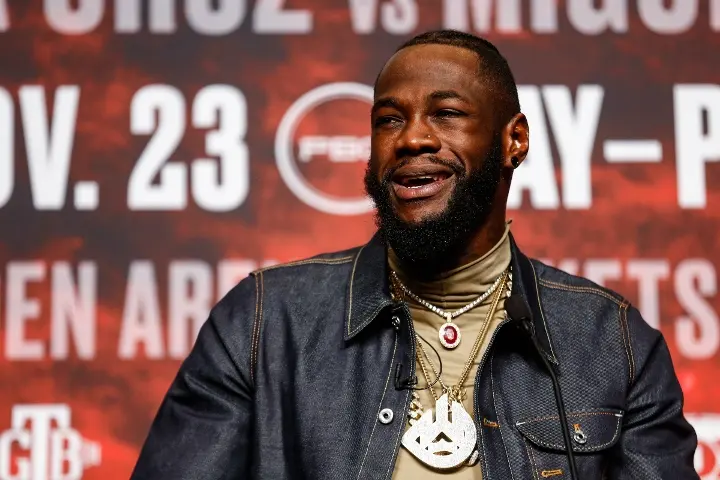
It’s eight weeks (or so) before a Deontay Wilder fight.
But it doesn’t sound the same.
By this point in the fight-selling process the “Bronze Bomber” has usually issued an inappropriately chilling threat, suggested rendering an opponent lifeless wouldn’t cause him to lose sleep, or at the very least proclaimed himself well on his way to undisputed heavyweight domination.
This time around, though, not so much.
Some have surmised a quiet Wilder means a rededicated and refocused Wilder, two descriptions he’ll surely need to have any hope of reversing the result of February’s TKO loss to Tyson Fury in Las Vegas.
In case you’ve forgotten, that’s the fight in which Wilder lost nearly every moment of every round, was dropped twice and ultimately saved from further damage when trainer Mark Breland tossed a towel.
The surrender came 14 months after he and Fury met the first time in Los Angeles and Wilder scored two knockdowns, the latter on a dramatic final-round combination that was enough to get him a charitable majority draw thanks to a timely 10-8 round from judge Phil Edwards.
Fury, in fact, became the first foe to survive a full-on Wilder onslaught. He not only rose from the late knockdown, but evaded the then-champion’s amateurish follow-up of looping right hands and was able to recover and land shots of his own that had Wilder wobbled and reeling at the final bell.
The two fights aptly illustrated Wilder’s need for further schooling.
The remedy of choice for Team Wilder? Fire Breland.
Indeed, the only recent peeps from the outspoken Alabaman’s camp came in the form of a confirmation from adviser Shelly Finkel that Breland, an Olympic gold medalist and former two-time world champion, would not be working the corner in the trilogy fight with Fury.
The lead role, as of now at least, will be handled by longtime team member Jay Deas, who’ll work with another veteran colleague in Malik Scott. That’s apparently in spite of offers to work with Wilder in the Fury aftermath that have come from fellow ex-champs George Foreman and Larry Holmes, two-time title challenger Gerry Cooney and consensus pound-for-pound elite Floyd Mayweather Jr.
As much as I admire Wilder’s loyalty, I question his judgement.
Though his Olympic bronze medal and five-year, 10-defense run as WBC champion conceivably validate whatever approach the fighter chooses, it’d make more sense – given the comprehensive nature of the beatdown Fury administered – that he broaden his horizons beyond that of familiar yes men.
For all the highlight-reel success he’s had with Deas, Scott and the other lingering entourage members, Wilder in many ways remains the same fighter he’s been since early in his career. A dynamic athlete with a pterodactyl wingspan who relies almost exclusively on his ability to land fight-defining punches.
It worked against the likes of Eric Molina, Bermane Stiverne and Artur Szpilka, among others, but the first time he encountered an opponent with the wherewithal to survive the storm, he was doomed.
Which is exactly why a change is needed before he faces the same boogeyman again.
“Take Breland out and it’s just Deas,” said Randy Gordon, former chairman of the New York State Athletic Commission. “It’s obvious Deas has only been able to teach him so much or that Deontay is so in love with his right hand that he’s forsaken body punching, body hooks.
“He’s got a long jab but it’s got a low IQ.”
To be fair, Wilder is certainly not the first fighter to fall head over heels for his own power. He believes he can just go out and hit a guy to win fights and no one other than Fury has proven him wrong, which will make it awfully hard to dissuade him. Not to mention, he’s a confident world-class athlete who thinks his own talent – which has provided a lot of success for a lot of years -- is more than enough.
After all, who knows if anyone would take the gig eight weeks before a fight? And if anyone did, who knows if it’d be someone Wilder would actually listen to?
But it would behoove him to gauge the interest.
Because if things stay as is, Gordon remains skeptical.
“If he goes in 10 months later without changing anything, he’s going to lose again,” he said.
“He doesn’t have to be concerned with body punching or inside fighting. Just make it about one thing: how to throw the jab. Educate the jab.”
Sadly, the trainer who may have done Wilder the most good is forever unavailable.
Emanuel Steward worked wonders with a gangly Detroit welterweight with a long reach and a huge right hand, then made dominant long-term champions out of a pair of recent heavyweights – Lennox Lewis and Wladimir Klitschko – whose most defining characteristics were height, length and power.
Lewis was 6-foot-5 with an 84-inch reach. Klitschko was 6-foot-6 with an 81-inch reach.
They combined for five title reigns and 36 title defenses.
Wilder, by the way, is 6-foot-7 with an 83-inch reach.
“Emanuel would have tried to influence him to stand back, never give away his height and reach advantages, don't lunge forward, make opponents increase their own vulnerability by coming forward toward his power,” said Jim Lampley, who called Lewis and Klitschko fights on HBO and worked with Steward during the late trainer’s time as an expert analyst. “Taller fighters should stand up and fight tall, bigger fighters should always fight big. That doesn't appear to be the way Deontay sees it.”
* * * * * * * * * *
This week’s title-fight schedule:
FRIDAY
Vacant WBO featherweight title – Las Vegas, Nevada
Emanuel Navarrete (No. 1 WBO/Unranked IWBR) vs. Ruben Villa (No. 2 WBO/No. 24 IWBR)
Navarrete (31-1, 27 KO): Seventh title fight (6-0); KO/TKO wins in five title defenses at 126 (34 rounds)
Villa (18-0, 5 KO): First title fight; First fight scheduled for 12 rounds
Fitzbitz says: Villa’s got skills and a record but he doesn’t have the sort of pop it’ll take to keep Navarrete away for 36 minutes. Eventually, the 122-pound champ makes it a double. Navarrete in 9 (99/1)
SATURDAY
IBO light heavyweight title – Magdeburg, Germany
Dominic Boesel (champion/No. 11 IWBR) vs. Robin Krasniqi (Unranked IBO/Unranked IWBR)
Boesel (30-1, 12 KO): First title defense; Unbeaten since lone career loss in 2017 (6-0, 3 KO)
Krasniqi (50-6, 18 KO): Third title fight (0-2); Lost WBO title shot in 2013 and WBA title shot in 2015
Fitzbitz says: The German champ is on the brink of top-10 recognition and maintaining his IBO belt here will keep him relevant. Krasniqi is a level below championship status. Boesel by decision (90/10)
Last week's picks: None
2020 picks record: 24-3 (88.9 percent)
Overall picks record: 1,141-368 (75.6 percent)
NOTE: Fights previewed are only those involving a sanctioning body's full-fledged title-holder – no interim, diamond, silver, etc. Fights for WBA "world championships" are only included if no "super champion" exists in the weight class.
Lyle Fitzsimmons has covered professional boxing since 1995 and written a weekly column for Boxing Scene since 2008. He is a full voting member of the Boxing Writers Association of America. Reach him at fitzbitz@msn.com or follow him on Twitter – @fitzbitz.