Golovkin Prepared To Deliver Drama on The PPV Stage

Oct 11, 2015 • 2:59 AM ET
By Jake Donovan
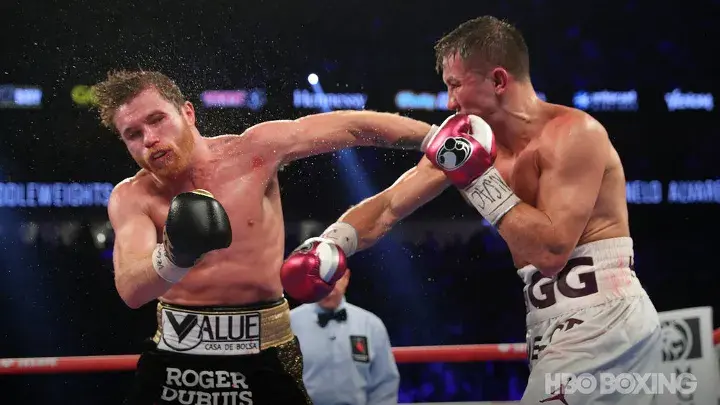
In less than a week, Gennady Golovkin faces perhaps his toughest test to date – not so much his challenge versus David Lemieux, but testing driving the Pay-Per-View market. The two collide October 17 at Madison Square Garden in New York City, with HBO to distribute through its PPV arm ($49.95 SRP).
If it’s anywhere nearly as close as everything else he and his team have tackled in his meteoric rise to stardom, chances are he will conquer that challenge as well. That the unbeaten knockout artist from Kazakhstan is already in this position to take on such a marketing risk says that much of his desire to succeed both in and out of the ring.
Of course, it’s what led American cable giant HBO to open the doors in the first place.
“From the very beginning, Gennady has always been very hands on with his own career,” notes HBO VP of Programming Peter Nelson, who has been with the network since 2011. “He has always engineered his career towards identifying him with the same cache the team around him represents.
“They always had a passion about first getting on HBO and then becoming a staple.”
The road to stardom began long before his network debut in 2012. More than two years prior, Golovkin – who rose to prominence during a brilliant amateur career that included a Silver medal earned for Kazakhstan during the 2004 Athens Olympics – was introduced to Abel Sanchez by his managers, Max and Oleg Hermann.
The meeting at Sanchez’ camp in Big Bear was the starting point of a tight-knit relationship five years and counting. By no small coincidence, it has also run the full duration of his current title reign, having claimed an interim belt in a knockout win over Milton Nunez in August 2010.
From that moment came the desire for greatness. What was lacking, however, was the platform to expand his brand. Golovkin was still under contract with Germany-based outfit Universum Promotions, managing to break free from its controls in 2011.
Once a free agent, Golovkin was led to the Klitschko brothers’ K2 Promotions, and in the four years that followed a professional relationship with its managing director Tom Loeffler, who has tirelessly beat the drums in efforts to expand his fighter’s profile.
“The work that they've been able to do is a personal as well as a professional relationship,” Nelson points out. “They were always aligned in the same mission, becoming a star in America.”
Golovkin’s first fight under the K2 banner came as a makeshift main event after World heavyweight champion Wladimir Klitschko was forced to delay an eventual title defense versus Jean-Marc Mormeck. He was moved into the lead spot, with the show bumped up by a day and moved to a new location.
None of this was of any concern to the two-fisted puncher, who drilled the normally durable LuJuan Simon in the opening round of their Dec. ’11 middleweight title fight. Two fights later, Golovkin was making his stateside and HBO debut, but was long ago on everyone’s radar.
“Previous to my working at HBO, I remember as a journalist discussing at ringside with guys like (BoxingScene.com News Editor) Steve Kim and (RingTV.com Editor) Doug Fischer who the best middleweights in the world were,” recalls Nelson. “Even at that time, I’m not sure we knew how good he truly was, but there was already a sense of what he would do, given his devastating results.”
Golovkin had already racked up 10 straight knockouts and four consecutive title defenses by the time he appeared in front of an HBO camera for the first time. That moment came in Sept. ’12, tearing through Poland’s Grzegorz Proksa in the 5th round of their main event in Verona, New York.
His emergence as a potential rising star came at the perfect time for HBO, given how the next few months would shake out.
Floyd Mayweather was months removed from a 12-round win over Miguel Cotto, and had just finished a brief prison stint while figuring out his next move. It eventually led to his jumping ship to Showtime, signing a lucrative six-fight deal in early 2013, at which point a large number of fighters with Golden Boy Promotions and/or adviser Al Haymon – including then-unbeaten Golden Boy crown jewel and super welterweight champ Saul ‘Canelo’ Alvarez - had already crossed the street.
By that point, Cotto had also taken his business to the other side, though he would eventually return. Manny Pacquiao suffered a devastating knockout loss to Juan Manuel Marquez, with his marketability never fully restored to his previous longtime role as one of the sport’s biggest worldwide attractions.
Julio Cesar Chavez Jr. suffered his first loss – and a subsequent suspension following a second failed drug test – while his conqueror, World middleweight champ Sergio Martinez was entering the twilight of his career.
Given the need for a fresh new face, Golovkin not only fit the mold but redefined the manner in which boxing stars are developed.
To this day, charisma still exceeds his ability to articulate his thoughts in proper English. Still, there exists no language barrier as his out-of-the-ring charm and in-the-ring desire for action fights has not only taken his career to new heights, but also helped re-establish HBO’s place atop the industry.
In all, Golovkin has appeared on HBO eight times, seven of which have come as a headlining act. Wins over Curtis Stevens (Nov. ’13), Marco Antonio Rubio (Oct. ’14) and Willie Monroe (May ’15) registered as among the most watched fights of the respective years, a remarkable statistic considering the aforementioned B-side opponents never brought to much in the way of drawing power.
An 11th round knockout win over Martin Murray in February – the deepest Golovkin has ever been forced to go in a fight, to date – pulled in just under 900,000 viewers for a Saturday afternoon telecast, an unheard of number. Combined with the same-day evening replay, more than 1.4 million viewers bore witness to a performance that took place in a 900-seat room in Monte Carlo.
The ‘2 Days’ pre-fight segment featuring Golovkin prior to his Julne knockout win over Matthew Macklin drew 3.4 million gross viewers, the most watched in the series’ history.
Massive crowds have piled in for knockout wins over Rubio (sold-out StubHub Center) and Monroe (more than 12,000 at The Forum in Inglewood, Calif.), both of which served as his first two West Coast appearances.
His return to the East Coast has resulted in a sold-out Madison Square Garden venue for his upcoming unification bout with Lemieux (34-2, 31KOs).
Simply put, Golovkin has reached a point where he commands the attention of everyone in the industry – and now spilling over into the mainstream.
“What has caused people to gravitate towards Gennady is his humility as well as his gifts in the ring,” notes Nelson. “He and his team are maximizing the opportunities he, quite frankly, wasn’t given with his previous promoter. He’s never been given anything; everything he’s achieved, he’s fully earned.
“He’s always said he’s willing to fight everyone. He has delivered. Even when they went into the Proksa fight, they did not even have a rematch clause on the fight as champion. That tells you their level of confidence every time he steps into the ring.”
While not looking past Lemieux, there is additional motivation in taking on such a challenge at this time. In addition to the two titles he owns and the one around Lemieux’s waist that he desires to capture. Golovkin also holds an interim title that says he is the mandatory challenger to the winner of the November 21 showdown between Miguel Cotto and Saul ‘Canelo’ Alvarez.
In fact, a middleweight boom is taking place in the fourth quarter of 2015. Along with the two aforementioned blockbuster events, there is the December 5 all-Brooklyn showdown between Daniel Jacobs and Peter Quillin, and the oft-postponed clash between Andy Lee and Billy Joe Saunders now back on the docket for December 19.
All of the fights intrigue Golovkin, not just because they feature his middleweight peers, but because of what’s at stake in each fight.
“I want to unify the middleweight division; I want to fight everyone with a title,” insists Golovkin, never with a hint of hesitation or concern over boxing politics that could prevent certain matchups.
His goal is to become the face of the middleweight division. That desire – as well as that of all-action fights (“I fight, I don’t dance”) - has allowed him to serve as the face of HBO, if not the poster child of all that is right with a sport that far too often finds ways to get it all wrong.
“He wants to deliver for his fans. He likes to perform for his fans,” Nelson says of the 33-year young boxing phenom. “One of the beautiful things about boxing - an athlete from Kazakhstan, who spent his early years in Germany, and trains in Big Bear, Calif. can fight in New York and become a worldwide sensation. That type of merit will always wind up succeeding.”
Jake Donovan is the managing editor of BoxingScene.com.
Twitter: @JakeNDaBox
Facebook Page: JakeBScene
Jake Donovan is an award-winning journalist who served as senior writer for BoxingScene from 2007-2024, and news editor for the final nine years of his first tour. He was also the lead writer for The Ring before his decision to return home.