“Fighting Words” - The Rebuilding of Broner Continues

Sep 8, 2014 • 1:45 AM ET
by David P. Greisman
Each of the previous two times Adrien Broner headlined at the U.S. Bank Arena in of Cincinnati had been a momentous occasion.
There was his first world title fight, which took place on the weekend after Thanksgiving in November 2011, a fitting time for a homecoming. He feasted on an outmatched opponent named Vicente Rodriguez, winning a vacant belt at 130 pounds.
He came back eight months later in July 2012, defending against another Vicente, this one a former contender with the surname of Escobedo. It was Broner’s first time as the main event on HBO. Previously he had performed on three shows underneath Canelo Alvarez and one featuring Devon Alexander.
Both of those milestones — titleholder, headliner — had been integral in building his future as a potential breakout superstar. His third appearance at this arena along the banks of the Ohio River and by Ohio’s border with Kentucky was no milestone, though it represented another notable stop along his career journey. This was no longer about building his future, but rather about rebuilding him so that he would still have one.
In a way Broner had become the prodigal son. He’d sought to establish himself and ended up failing himself. He’d then come back home, welcomed with open arms and celebrated upon his return, though it’s clear that he hasn’t completely learned the lessons of his mistakes.
He’s not yet a complete fighter, though he is full of himself.
He had gotten way with misbehavior and cutting corners. He has been shown the error of his ways and still hasn’t corrected all of them.
Perhaps the trouble began when Broner came in massively overweight against Escobedo, missing the 130-pound limit by three and a half pounds and dropping his title on the scales. That didn’t matter to him. He was an emerging star who had built a following by capturing some of Alvarez’s viewers and captivating others with his flashy combinations, fast hands and faster mouth. Broner-Escobedo brought in an average of 1.369 million viewers, the fourth-highest rating out of 18 main events on HBO in 2012.
He was already younger, quicker and better than Escobedo. He’d have the size advantage as well, an advantage bought off with a payment to an opponent who had no other opportunities ahead of him and thus had no choice but to accept the deal.
If that didn’t make Broner enough of a villain, there also were the photos of junk food and fast food he had tweeted out ahead of time. He claimed he had grown out of the weight class, and there may have been truth to that given that he’d begun his career heavier. But some felt Broner hadn’t cared about making weight, that there weren’t going to be consequences for a boxer who was signed with powerful adviser Al Haymon, who was working with powerful Golden Boy Promotions, and who was the latest darling of the most prominent boxing broadcaster in the United States.
He had his shtick, what with the rehearsed lines and jokes in interviews and with his father brushing his hair before and after fights. He had a following, as 1.056 million watched Broner take on Antonio DeMarco and an impressive 1.398 million tuned in for Broner vs. Gavin Rees. And he was getting results, trouncing DeMarco for a second world title, this one at lightweight, and then defending it by making relatively short work of Rees.
He hadn’t beaten the best opponents at 130 and 135, but already people were asking when he’d move up to 140. That was where the bigger names were, though many of these bigger names were tied up with each other. And so he went all the way up to 147 — and joined the migration of Haymon and Golden Boy fighters to Showtime — challenging Paulie Malignaggi for a welterweight world title.
Broner won, though it was a close split decision in a bout in which Malignaggi had his fair share of moments. That meant a third belt for Broner, and the victory came in front of an average audience of 1.28 million people, a very good figure, even more so for a network whose subscriber count was less than that of HBO.
The Malignaggi fight should’ve been a reality check for him. Broner was neither as quick nor as powerful at 147 as he had been at 130 and 135. That’s a given for most fighters who add pounds to their frame, excepting those who had been weakened by making the lower weight. And the move up took away a good bit of the speed advantage we sometimes see when a lighter fighters steps in with a heavier one. Broner also was less active, leaving windows for Malignaggi to send out his own shots.
Broner gained a noticeable amount of weight ahead of his fight with Marcos Maidana last December. He came in under 147 easily, but on fight night his reflexes were slower, and that proved to his detriment early. His feet and upper body movement had often delivered him away from danger before. Now punches that once may have missed by inches were landing more often and with greater impact. He’d been able to walk through the clean shots Rees had landed. Maidana hurt Broner, however, knocking him down twice and taking a decision and the world title.
The Maidana fight once had previously been scheduled to be Broner’s pay-per-view debut, establishing the expectation that fans would need to pay more to see him. Instead, the business of boxing and a glut of pay-per-views landed Broner-Maidana on Showtime. An average of 1.268 million people — many of whom wanted to see him win, many of whom were waiting to see him lose — watched the network as Broner’s record received its first blemish. Even more people likely tuned into replays or found illicit copies of the bout online.
That meant 2014 would serve a different purpose. Instead of being the year that would launch him into orbit, it became a matter of keeping him from crashing and burning.
Broner indeed debuted on pay-per-view, but it was underneath Mayweather’s win this past May against Maidana, Broner’s conqueror. He dropped down to 140 pounds, a more natural weight class for his frame, taking a workmanlike decision over Carlos Molina.
That brought him into this past weekend’s card in Cincinnati, with Broner taking on Emmanuel Taylor, a fringe contender who had lost to future titleholder Chris Algieri but who had beaten former title challenger Victor Cayo and prospect Karim Mayfield.
Days before the bout, Broner was reflective.
“I learned I need to stay in shape,” he said during a workout session held for media members. “Before the Maidana fight it felt like I was unstoppable. I could do anything. I could just go back in the ring and everything would be normal. But after the fight I realized I have to slow down. I can still be me and have fun, but I can't be beating up my body. I have no more flaws. I put down everything. Now I just have fun, I stay in shape and I keep positive people around.”
This was coming from a young man who had elevated his stature with shenanigans, with videos of sexual acts in strip clubs and elsewhere, with attention-grabbing tweets and a clip of him flushing money down a fast-food restaurant toilet, with an arrest in Miami Beach and with claims before the Malignaggi fight that he was sleeping with one of his opponent’s former flames.
He is a 25-year-old who is a father of five children. He grew up in a poor neighborhood and has spoken of being able to change the lives of his friends, family and kids.
His idol, Floyd Mayweather Jr., had advised that Broner needed to know when to turn on and off the behavior that would make him an antihero to his fans and a villain to the rest. It is a tightrope Broner was walking in an attempt to transcend into mainstream recognition with his personality before his actual accomplishments merited it.
Despite the talk of changing his ways out of the ring, there’s still much to be worked on with what he does on fight night.
There were still periods of inactivity that allowed Taylor to land well to the body and head, offense that helped him take a handful of rounds on the scorecard. The footwork still needs fine-tuning as well. At 130 and 135, Broner had been tall and quick and able to use those physical advantages to walk opponents down, move back out of harm’s way, or win exchanges in-close or on the ropes.
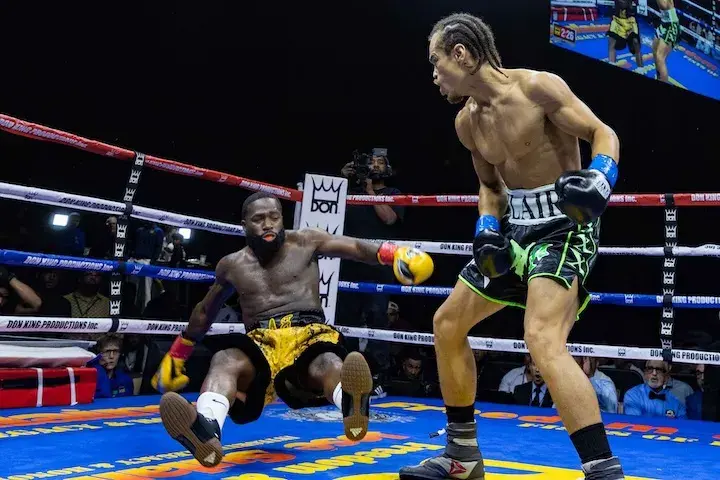
A few flashes of brilliance surfaced, including a flurry that punctuated the 10th round and then the decoy pitty-pat punches to Taylor’s earmuffs that set up a cleanup uppercut, scoring a knockdown just before the final bell in the 12th. Broner won a unanimous decision, 116-111 (eight rounds to four, with an additional point taken from Taylor due to the knockdown) on two scorecards and 115-112 (seven rounds to five) on the other.
These flashes were just occasional. Against Rodriguez, Eloy Perez and Escobedo, Broner had averaged a little more than 50 punches thrown per round, according to CompuBox. That climbed to 56 per round against DeMarco and 61 against Rees. But then he dropped to 44 in the Malignaggi bout and, against Maidana’s pressure and whirlwind attack, just 33 punches every three minutes.
His pace had picked back up against Molina, with Broner averaging 61 per round. That wasn’t the case against Taylor; Broner threw an average of 44 per round.
It’s as if something is missing, as if he loses focus during fights, as if he fell in love with the trappings of stardom and then fell into a trap of no longer sustaining the effort that had brought him there.
The rebuilding of Adrien Broner continues, then. He spoke afterward of wanting to face Lucas Matthysse, who fought on the undercard in Cincinnati. Fans had called for Broner to face Matthysse a year ago, back when Matthysse was on a tear in the junior-welterweight division and back before Matthysse lost to top 140-pounder Danny Garcia. Instead, Broner went on face another Argentine brawler in Maidana.
Even though Broner has captured world titles in three divisions, a win against Matthysse would mean a victory over by far his best foe yet.
He’s already proven himself to be prodigal. He still has much to do to show whether he can be a prodigy.
The 10 Count
1. The end of Lucas Matthysse’s win over Roberto Ortiz this past Saturday on the undercard to Adrien Broner-Emmanuel Taylor was reminiscent of the conclusion to Dereck Chisora’s victory over Malik Scott last year.
In both cases, a downed fighter quickly rose from the canvas once the referee reached nine. And in both cases, the referee ruled that the fighter had failed to beat the count.
It was the wrong call in both cases, no matter what the referees said and no matter what the rules say. In Saturday’s case, Benjy Esteves ended the bout prematurely.
Let’s talk about the rules, though. Contrary to what we may believe, and contrary to what Showtime’s Brian Kenny said, a fighter is not considered to be “up” the moment his knee is off the canvas.
Under the unified rules of the Association of Boxing Commissions: “The boxer is to be considered to still be in a downed position when rising from a knockdown.”
But there should be a difference between the letter of the law and the spirit of the law. A fighter who rises immediately as the referee is at nine very well may be “up” just as the referee is reaching 10. This creates what in baseball would be called a “bang-bang play.” That creates far too easy an opportunity for error.
Just my opinion, but a boxer should be allowed to continue if he rises immediately after the count of nine and isn’t unsteady or stumbling. Otherwise, referees might as well say that boxers need to beat “the nine count” — and suddenly I’ll have one fewer item I’d need to write about in this space each week.
2. Typically when a fighter has some struggles after a 13-month layoff and a return from an injury, it can be chalked up to the shaking off of rust. That’s not the way that Andre Berto’s win over Steve Upsher was being viewed by some this past Saturday on the undercard to Adrien Broner vs. Emmanuel Taylor.
Berto took a clear, wide unanimous decision over Upsher, a decent lower-level boxer from Philadelphia who has now lost three times in a row. Upsher was outpointed by Luis Collazo in October 2012, returned 10 months later to get stopped in four rounds by Eddie Gomez in August 2013, then spent another year out of the ring before landing a spot opposite Berto in Cincinnati.
Berto still showed many of the flaws that had plagued him before. He was nevertheless able to capture a vacant world title against a handpicked gimme opponent in Mikki Rodriguez and make five successful defenses against Steve Forbes, Luis Collazo, Juan Urango, Carlos Quintana and Freddy Hernandez. It remains clear that Berto will never be a top-flight welterweight, though.
Yet flawed fighters can be fun. That was the case with Berto’s losses in a war with Victor Ortiz and a battle with Robert Guerrero. And Berto also showed guts fighting through injury before getting stopped by Jesus Soto-Karass last year.
Just because he’s being written off doesn’t mean he should be off television.
3. If Andre Berto showed rust with anything, it was in his post-fight interview. After all, it took him exactly two full minutes to remember to thank Al Haymon.
He thanked Jesus Christ first. He referenced his sparring and his work with trainer Virgil Hunter. He spoke of his appreciation for the support that super middleweight champion Andre Ward gave him. He thanked his family.
And, finally, he got to Haymon. I’m guessing someone nudged him.
If you looked over Showtime interviewer Jim Gray’s shoulder during the post-fight chat, you saw Sam Watson, who is so prominent in his work for Haymon that many people mistakenly think that he is Haymon.
The moment after Berto finally thanked Haymon, you would’ve seen Watson break into a little smile and nod his head.
For something even funnier, go back and watch Adrien Broner’s post-fight interview after his June 2011 win over Jason Litzau. Broner had recently signed with Haymon, but mistakenly he thanked his former manager, Shelly Finkel, instead.
Here are a few screen caps of Sam Watson and son Marcus Watson reacting in the background:
4. If you haven’t yet watched Roman Gonzalez unseat flyweight champion Akira Yaegashi, and if you haven’t yet seen unified flyweight titleholder Juan Francisco Estrada take out Giovani Segura, and if you missed junior featherweight Carl Frampton take a world title from Kiko Martinez in their rematch this past Saturday, then go watch them.
I’ll wait here until you return.
You should catch up on Frampton, who is the second-best Carl currently donning a pair of gloves in the United Kingdom. American audiences are of course most familiar with a pair of junior featherweights named Guillermo Rigondeaux and Leo Santa Cruz. They should find ways to follow Frampton (who hails from Northern Ireland) and Scott Quigg (who is from England).
And we should all salivate at the prospect of a rematch between Gonzalez and Estrada. Their first bout took place in November 2012 in the 108-pound division, with Gonzalez taking a unanimous decision.
They are offensive dynamos and a pleasure to watch.
Three of the best things to watch in the ring this past weekend were 112, 112 and 122 pounds. And I’m not talking about the ring card girls.
5. Why are boxing fans so upset that middleweight Peter Quillin dropped his world title rather than face mandatory challenger Matvey Korobov? Because it’s a decision that for the moment does not make much sense — and could make him fewer dollars.
The press release sent out last week said Quillin was declining to face Korobov so that he could pursue bigger opportunities at 160 pounds.
“This is a difficult decision, but in order to make the fights the fans and I want against my fellow middleweights at the top of the division, I needed to relinquish the title,” Quillin was quoted as saying in a statement ascribed to him.
Here’s the thing: Quillin-Korobov was expected to take place on Nov. 1 in Washington, D.C. The promoter would’ve been Roc Nation Sports, the company owned by Jay-Z, which has neither Quillin nor Korobov in its stable.
If Quillin hadn’t wanted to face Korobov and wanted to face bigger names at 160, then why hadn’t he dropped the belt sooner, given that Korobov was his mandatory and that a purse bid had been scheduled?
If Quillin’s team had bigger things in mind, then why did Golden Boy Promotions, which works with Quillin and adviser Al Haymon, put in a $1.2 million purse bid for the bout?
Some are speculating that Quillin-Korobov won’t be happening because of Haymon and the Jay-Z dynamic. Jay-Z’s wife, musical superstar Beyonce, once sued Haymon. Now Jay-Z could be vying to become an influential rival.
Quillin would’ve been paid $1.4 million for this fight, a bout that he would’ve been favored to win. According to Dan Rafael of ESPN.com, that’s “more than three times his biggest payday.”
There has long been talk about a bout between Quillin and his fellow Brooklynite stablemate Daniel Jacobs. That match wouldn’t have gone away. Quillin could’ve beaten Korobov and then gone on to face Jacobs. It’s also uncertain whether Quillin would get paid as much to face Jacobs as he would’ve for the Korobov bout.
As for whether there are bigger things down the line? That remains to be seen.
Miguel Cotto still needs an opponent for early next year. Gennady Golovkin may need a foe next year as well. Those fights seem unlikely, given the promotional and network affiliations.
Perhaps Canelo Alvarez will move up to 160 sometime soon. Or perhaps there’s not actually anything in mind yet.
We can only judge for what we know right now, though this decision still could prove to be the right one in the grand scheme.
Quillin must be hoping that it was.
6. Boxers Behaving Badly, part one: Floyd Mayweather Jr. is facing a civil lawsuit from his former girlfriend Shantel Jackson, who was better known as “Ms. Jackson” during their relationship.
The lawsuit was filed last week in California. Jackson, who is being represented by famed attorney Gloria Allred, is seeking damages from Mayweather for 11 categories of allegations, including assault, battery, invasion of privacy, defamation, false imprisonment, harassment, infliction of emotional distress and more.
Allred provided BoxingScene.com with a statement and a summary detailing the allegations. Those can be found at http://bit.ly/floydshantellawsuit
7. It will be interesting to see whether the final episode of Showtime’s “ALL ACCESS: Mayweather vs. Maidana 2” — which airs this Wednesday and which has Floyd Mayweather as one of its executive producers — has any mention of the lawsuit filed against him by Shantel Jackson.
Both Mayweather and Manny Pacquiao have been able to achieve great success despite the variety of distractions in their lives, many of which they brought on themselves. That doesn’t make the accusations against Mayweather any less of an important story to cover.
It’s significant that Mayweather is once again facing accusations that he assaulted a woman. It’s also significant, though not at all surprising, that the lawsuit was filed just before Mayweather’s next fight, a time when the case can capture headlines and put pressure on the defendant.
Sadly, I won’t be surprised if the final episode doesn’t mention the accusations or quickly glosses over them. After all, these shows aren’t documentaries so much as advertisements. They are in the business of selling a fight. It wouldn’t help that purpose to present this lawsuit or put these accusations in the context of a pattern of behavior. And it wouldn’t do the network any favors with its superstar business partner.
(This isn’t limited to Showtime. Other broadcasters, be they sports or news networks have made unfortunate decisions in which they allow their business relationships to alter the way that reporting is done or presented.)
8. Boxers Behaving Badly, part two: Former lightweight contender Michael Katsidis has been charged with burglary after allegedly breaking breaking into a house in late July, according to Australia’s Fraser Coast Chronicle.
Though the alleged crime took place on July 24 and was reported to police on July 27, Katsidis was officially charged on Sept. 3. “His burglary matter is due to be mentioned in Brisbane Magistrates Court on September 30,” the report said.
Katsidis returned this past March after about two years out of the ring, scoring a third-round technical knockout over some dude named Eddy Comaro. He then won a rematch with Graham Earl in July and is scheduled to face Tommy Coyle this October.
The 34-year-old is 30-6 with 24 KOs. His record includes wins over Jesus Chavez and Vicente Escobedo, and losses to Joel Casamayor, Juan Diaz, Juan Manuel Marquez, Robert Guerrero, Ricky Burns and Albert Mensah. He had been the WBO’s interim titleholder at 135 twice.
9. Here’s wishing a speedy recovery for Kell Brook, the newly crowned welterweight titleholder who was stabbed in his leg while on vacation in the Canary Islands, according to the Daily Mail.
It’s a shame that this comes when Brook has finally reached the moment he’s worked for his entire career — though of course there would never be a good time for this to happen.
The incident and injuries mean that Brook’s planned homecoming defense is being postponed from December into 2015. And it remains to be seen whether that change in timing could also have an effect on Brook’s hopes of convincing fellow British welterweight Amir Khan to face him next year.
10. It’s bizarre enough that we’re getting televised main events in the next month featuring Antonio Tarver (Sept. 29) and Jermain Taylor (Oct. 8). But then last week brought official confirmation that we’ve fallen into the Hot Tub Time Machine and transported back a decade or so.
That’s because a Sept. 27 show in Oklahoma City will have a pair of main events featuring Samuel Peter and Ricardo Mayorga.
No, really.
Mayorga became the lineal welterweight champion back in 2003 when he beat Vernon Forrest by technical knockout and then won a majority decision in the rematch. He lost the championship to Cory Spinks by the year’s end. Mayorga lost to Felix Trinidad in 2004, to Oscar De La Hoya in 2006, beat Fernando Vargas in 2007, lost to Shane Mosley in 2008 and lost to Miguel Cotto in March 2011.
The Cotto defeat was his last boxing match. Last year Mayorga turned to mixed martial arts, going 0-3 with 1 no contest, according to Sherdog. He’ll turn 41 a week after this upcoming fight.
Peter, meanwhile, had his first bout with Wladimir Klitschko way back in 2005, picked up wins over James Toney in 2006 and 2007, was a heavyweight titleholder in 2008 and lost the belt to Vitali Klitschko later that year. He was last seen losing a couple of bouts by knockout: in a rematch with Wladimir Klitschko in 2010 and in a fight with prospect Robert Helenius in April 2011.
Somehow he is listed at just 34 years old.
But wait: There’s more!
Yory Boy Campas is also on the card, though at 43 years old it’s far past time he changed his nickname to “Yory Man.”
Campas, whose record is an eye-catching 102-17-3 with 79 knockouts, last fought for a world title in 2003, getting stopped by De La Hoya.
He’s at least been active over the years for whatever reason, with three fights in 2010, five fights in 2011, two fights in 2012 and three fights in 2013. His last appearance was in April, a unanimous decision over a guy named Daniel Gonzalez whose record was listed at 9-30-2.
This past weekened, Nicaraguan television — yes, I watched it for its broadcasts of Akira Yaegashi vs. Roman Gonzalez and Juan Francisco Estrada vs. Giovani Segura — advertised that it would be showing the Mayorga bout.
As far as I know, it won’t be on American television.
The case would be otherwise if any of these three were signed with Al Haymon…
“Fighting Words” appears every Monday on BoxingScene.com. Pick up a copy of David’s book, “Fighting Words: The Heart and Heartbreak of Boxing,” at http://bit.ly/fightingwordsamazon or internationally at http://bit.ly/fightingwordsworldwide . Send questions/comments via email at fightingwords1@gmail.com