“Fighting Words” — David Lemieux and Goliath Golovkin
Oct 12, 2015 • 1:38 AM ET
by David P. Greisman
The fight this Saturday between Gennady Golovkin and David Lemieux doesn’t need to be Marvin Hagler vs. Thomas Hearns. It likely won’t be. It likely can’t be. It shouldn’t even draw the comparison, which is both forced and hopeful.
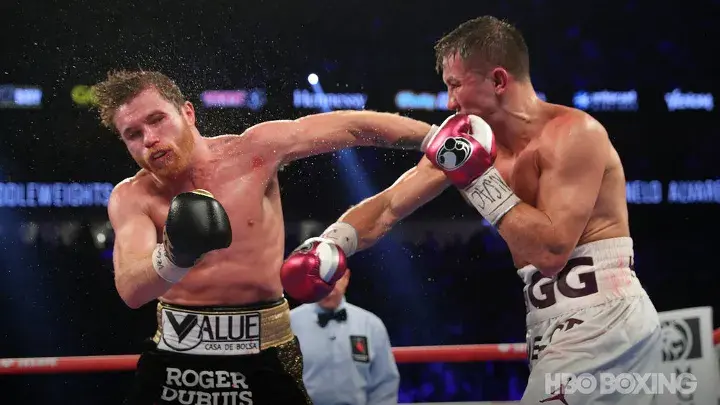
Golovkin-Lemieux draws the comparison because they are two middleweights we want to see hit each other very hard and very often. It draws the comparison because they are two powerful punchers and we don’t believe the fight will last very long, though the fight will be fun for as long as it lasts.
But really, it draws the comparison because that’s what people in boxing do. For whatever reason, everything seems to need historical context.
That’s not just limited to speaking statistically. Sure, it’s dubious to relate Wladimir Klitschko’s 18 heavyweight title defenses to the 25 made by Joe Louis when it’s not an apples to apples comparison, given that every Louis defense was of the lineal heavyweight championship while 11 of Klitschko’s have been so. That’s still better than forcing every fighter to be reminiscent of someone in the past, and portraying so many fights as being akin to another one from years ago.
It’s not necessary. There’s plenty of context in the sport as it is now, and it’s less of a stretch to tie someone or something to a more recent counterpart.
Hagler was a long-established and proven commodity when he met Hearns in 1985. He’d gone nearly a decade without losing, had been both a titleholder and the lineal champion since 1980, and had made 10 successful defenses with nine of those ending by knockout. Hearns was moving up in weight from his time as a 147-pound titleholder and 154-pound champion. He was less than a year removed from his huge one-punch knockout of Roberto Duran. His only loss at the time was in 1981 to Sugar Ray Leonard.
Their eight-minute war set a standard that is nearly impossible to match. Every 12-month period brings Fight of the Year candidates and award winners. The greatest battles are far rarer and therefore are easy to name: Hagler-Hearns, Corrales-Castillo, Gatti-Ward, Ali-Frazier.
That’s not to take away from Golovkin-Lemieux. It very well could join the pantheon. But to say that it could be Hagler-Hearns is to set an unfair bar. This weekend’s pay-per-view main event can bring excitement without exaggeration. It is good for what it is.
What it is, well, is a collision of heavy hitters who each believe his opponent hasn’t faced anyone like him before.
Golovkin is 33-0 with 30 knockouts, winner of 20 straight fights within the distance, the consensus No. 1 guy at 160 even though he’s not yet been able to get any of the other top middleweights to face him, and even though there’s still a lineal champion in the division, a guy (Miguel Cotto) who beat the guy (Sergio Martinez) who beat the guy (Kelly Pavlik) who beat the guy (Jermain Taylor) who got a pair of debated decisions over the guy (Bernard Hopkins) who began the lineage anew in 2001.
Golovkin held the World Boxing Association’s secondary “regular” title dating back to 2010 at a time when Felix Sturm (and, later, Daniel Geale) was the organization’s “super” champion. This sanctioning body’s love of issuing multiple belts to fighters in the same weight class can lead to confusion, but it’s important to note when a belt someone holds isn’t as valuable as another one. When the WBA stripped Geale in late 2012, Golovkin became its primary titleholder and has defended his belt nine times since then.
Sturm never defended against Golovkin. Neither did Martinez. Cotto’s shown little interest. There’s never been any inkling that the middleweights signed with Al Haymon — and appearing on Showtime before Haymon’s Premier Boxing Champions launched — were demanding a fight with “GGG,” who was being featured on HBO.
Golovkin is 33 years old and more than nine and a half years into his pro career, but his best wins still are Geale, who was by mid-2014 a former titleholder, and Martin Murray, a contender who’d come up short in a draw with Sturm and a decision loss to Martinez. Geale and Murray were demolished in a way no one else ever had done to them. That’s what Golovkin has been doing to pretty much everyone.
Lemieux’s record isn’t very deep either. His three most recent victories are his best ones: a third-round knockout of Fernando Guerrero, who’d long before been proven limited and chinny; a 10th-round stoppage of Gabriel Rosado, who hadn’t won in more than two years and always came up short against a certain tier despite putting up gutty efforts; and a unanimous decision over Hassan N’Dam, who had out-boxed Curtis Stevens to land himself in a bout against Lemieux for a vacant title.
That title had previously belonged to Jermain Taylor until Taylor’s legal troubles left him without. He’d beaten the undersized Sam Soliman for that belt. Soliman had beaten Felix Sturm. Sturm had made short work of an injured Darren Barker. Barker had edged Geale. Geale had defeated Sturm.
N’Dam was the same fighter who’d been knocked down six times against Peter Quillin but had gotten up each time. The judges still scored it seven rounds to five for Quillin; N’Dam otherwise would’ve made it close if not for the knockdowns. The same could be said for the bout between Lemieux and N’Dam this past June. Lemieux floored N’Dam four times. The scorecards had two judges giving Lemieux seven rounds while N’Dam was awarded five, and the third judge had it six rounds apiece.
With all of those caveats stated, this version of Lemieux was much improved from what we’d seen in 2011, back when he’d been written off as a suspect prospect who’d never contend. He’d been stopped in seven rounds by Marco Antonio Rubio, and then he’d lost a surprising decision to Joachim Alcine. Lemieux was only 22 at the time. He’s still a couple months away from turning 27. He needed time to learn. He needed to learn, in essence, that he needed to learn.
Lemieux, like Golovkin, has scored knockouts or technical knockouts in all but three of his wins. He’s still seen as the underdog, and validly so.
Max Kellerman, the HBO analyst with a penchant for overdoing historical comparisons, went biblical while moderating a conversation between the fighters as part of the network’s occasional “Face Off” series, calling this fight “David vs. Golovkin.”
The wordplay was cute and meant to be nothing but a play on the first three letters of Golovkin’s last name. There are a few similarities with the tale. Only a few.
Goliath for 40 days issued a challenge for someone to fight him. Golovkin has been waiting a while as well; this is his first chance at unifying two major world titles. He’s been far less boisterous about it.
Lemieux is growing into a star in his hometown of Montreal, but he also recognized the value in taking on the person seen as the best in his division.
“The king will give great wealth to the man who kills him,” the Israelites had said of Goliath. And David had been warned: “You are a young man, and he has been a warrior from his youth.”
David felled Goliath with a single shot, speed augmenting power, a perfectly timed and perfectly placed blow landed from a distance.
Lemieux may be better than the young man who lost to Rubio and Alcine, but he would still be wise to choose his spots and not to exchange often. Hagler vs. Hearns only worked out in the end for Hagler. The heaviest hitters can be done in by those who box wisely, those who block well, or those whose chins hold up while they return fire. Lemieux would be gambling if he thinks he can land first, most and best. As with nearly every boxing match, the winner is the one who can make his opponent miss while making his opponent pay.
Golovkin, meanwhile, has taken shots from hard punchers like Curtis Stevens. He still would be smart to protect his chin more than he did against lighter hitters like Willie Monroe who found homes for their hands.
That’s the context that matters. This doesn’t need to be Hagler-Hearns. It just holds the promise of entertainment and intrigue, of two fighters with knockout on their minds trying to be on the delivering end instead of the receiving end. Lemieux vs. Rosado had delightful exchanges. We’ll see how long Lemieux can hold up to Golovkin’s blows. Golovkin vs. Geale had “GGG” eating a punch and retaliating in the same sequence of motion. We’ll see if he can walk through flush shots from Lemieux.
The victor will be the best middleweight in boxing today and will wait to see if the winner of the Nov. 21 fight between Miguel Cotto and Canelo Alvarez will face him — true champions should take on true challengers, after all.
This fight doesn’t need any other historical context. It doesn’t even need to be a historical contest.
We just want it to live up to its own realistic expectations.
We want hard punches to be thrown, questions to be answered.
We want it to be fun while it lasts on Saturday — no matter how long that may make it last in our minds in the days, weeks, months and years afterward.
The 10 Count will return soon.
“Fighting Words” appears every Monday on BoxingScene.com. Pick up a copy of David’s book, “Fighting Words: The Heart and Heartbreak of Boxing,” at http://bit.ly/fightingwordsamazon or internationally at http://bit.ly/fightingwordsworldwide . Send questions/comments via email at fightingwords1@gmail.com