
“Fighting Words” - Crawford: The Quiet One You Gotta Watch
by David P. Greisman
Terence Crawford was the star of the show.
He was the headline fighter in the main event of a boxing card taking place in the Theater at Madison Square Garden in New York City and being broadcast on HBO. He was a two-division world titleholder with an undefeated record whose skills had landed him on lists of the best boxers in the world.
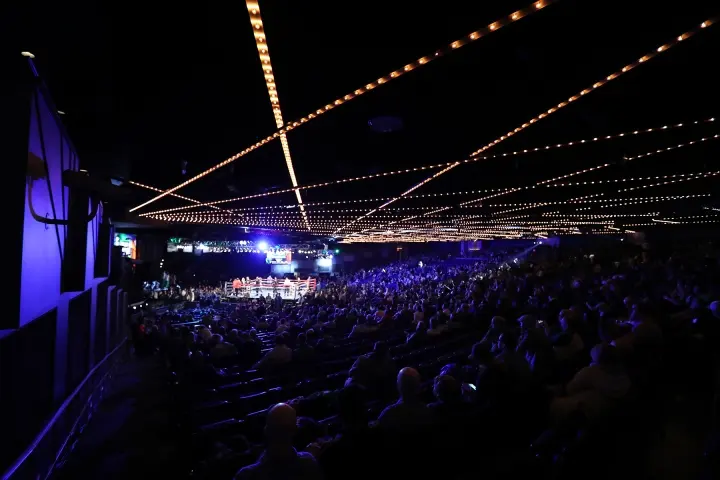
He was so beloved in his hometown of Omaha, Nebraska, that he’d packed crowds into an arena there and attracted a fair number of them to come from the Midwest to Midtown Manhattan, where his supporters — aided by the fans of a few other attractions on the undercard — helped sell out the venue with an announced attendance of more than 5,000.
He was the star of the show, but it was his opponent, Hank Lundy, who made for a spectacle.
Lundy was neither a star nor an attraction. He wasn’t one of the best boxers in the world or even in the junior welterweight division. He’d won just once in his past three fights. He was good enough to be competitive with other recognizable names in the 140-pound weight class but hadn’t been able to beat them. He felt he didn’t deserve those losses, that he’d been wronged, and that Crawford would be wrong to think too little of him.
Lundy wanted to remind Crawford — and boxing in general — of this.
“I’m not spoon-fed. I’ve been in there with the best,” Lundy said at one point. “The reason I am getting these fights is pretty clear: Nobody out there has beat my ass. And I can stick with that. Nobody has and nobody will.”
He acknowledged that Crawford was good but didn’t think of him as great. Lundy pointed to one of Crawford’s more notable wins — a 2014 battle with Yuriorkis Gamboa — as a sign of Crawford’s flaws.
“Gamboa, too small, but you see in that fight Gamboa hurt him. Little Gamboa. Gamboa was out-boxing him. What happen when you get a full junior welterweight that can punch and got dangerous speed? It’s a different type of monster. And then on the flip side of that, we’re fighting for a world title. You don’t know the electricity that’s running through my mind.”
Lundy felt other fighters he’d faced were better than Crawford — Viktor Postol, who outpointed Lundy in 2013 and has since gone on to win a world title, and Olusegun Ajose, whom Lundy beat by decision later that same year. He even said a bout between Crawford and Dannie Williams, who left the sport years ago after losses to Lundy, John Molina Jr. and Eloy Perez, would be “a toss-up.”
But the talk from Lundy had begun long before the fight with Crawford was signed. He’d been using Twitter to call Crawford out since June 2014. Crawford responded on a couple of occasions, and the bad blood was evident at the press conference announcing their bout.
Crawford has a tendency to be reserved with reporters, affable but brief with his responses, but on the podium he turned directly toward Lundy and tore into him. Lundy believed that meant he’d gotten into Crawford’s head.
All the talk wasn’t just mind games intended toward Crawford, but also for the sake of Lundy himself, boosting his confidence ahead of a fight that, trash talk aside, was going to be his toughest challenge. It also brought more attention to a show that might not otherwise have received as much.
Lundy may have felt that Crawford’s responses were a sign that the mind games were working. Crawford’s responses, however, were a way of showing Lundy that he was no pushover.
“Lundy runs his mouth too much. He’s going to get himself hurt,” Crawford said at one point.
“He’s going to wish he never talked his way into the fight,” Crawford said at another.
“This dude don’t know what he got himself into,” Crawford said at the final press conference just days before the bout. “Everybody say, ‘I’ma do this to him, I’ma do that to him, I see a flaw in this, I see a flaw in that.’ But when you get in front of me, you see a different thing. … Don’t blink, because it might be a quick one.”
Crawford was no pushover, and he shoved Lundy away as they stood in front of each other, jawing at the final press conference. The time for talk was over. It was almost time to fight.
“He’s going to come out fast, you know, looking sharp,” Crawford said. “But I’m going to keep breaking him down and breaking him down. I’ma frustrate him, and once things don’t start going his way he’s going to start getting wild. And once he starts getting wild, that’s when I’m gonna catch him.”
That’s exactly what happened.
Lundy had seen that Gamboa’s hand speed had helped him counter and catch Crawford. So in the first round of their fight this past Saturday, he moved forward and attacked from angles which boxers typically don’t punch from, knowing that fighters aren’t as used to responding to the unorthodox. Speed is incredibly important in boxing, but so too are where and when the punches are thrown. That was one reason why someone as crude as Ricardo Mayorga twice beat someone as talented as Vernon Forrest. And that’s why many of those punches from Lundy in the first landed on Crawford. It was a good round for Lundy, even if only one of the three official judges at ringside scored it for him.
Boxers only have a minute between rounds to rest, rehydrate, receive instructions from their trainers and think without simultaneously needing to dodge punches. They actually have less time once you subtract the seconds spent walking back to their corners. Crawford is very smart and very skilled, however, and that break between the first and second rounds allowed him to adjust.
He jabbed, sometimes pawing it in front of Lundy’s face, other times pushing his right hand into Lundy’s head. That kept Lundy at a distance, made him reset, changed the rhythm. When Lundy tried to come forward to attack, Crawford used his length and footwork to easily step back and out of range.
In the third round, Crawford began to land more left hands, adding power into the mix. By the fourth round, Lundy was frustrated enough to try to adjust as well, switching to southpaw. He was able to get closer to Crawford, yet that focus on reasserting himself on offense meant he was now in range for Crawford to put him in trouble.
Crawford landed a left hand in the fifth that wobbled Lundy. His follow-up punches put Lundy down. Lundy got up by the count of seven. His legs didn’t come with him. He had nothing left to keep Crawford away. Crawford came forward and landed shots to the head, forcing the referee to jump in and end the fight.
The truth is that Lundy was only nearly as good as several of the fighters who’d beaten him before, while Crawford is much better — more talented, more powerful, more complete.
Crawford had easily out-boxed Ray Beltran in 2014; Beltran edged Lundy in 2012. Crawford had knocked out Thomas Dulorme in 2015; Dulorme narrowly won a split decision over Lundy in 2014. Crawford was better than Mauricio Herrera, who won a close technical decision in a cut-shortened five-round bout with Lundy last year, and better than John Molina Jr., who came from behind to stop Lundy in 2010. Only Postol would present an interesting challenge to Crawford.
There’s a difference between being the spectacle and being the star of the show. Some fighters are both. Others, however, are only one, and it is better to be the one whose actions speak louder than your words rather than the other way around.
Terence Crawford isn’t boastful. His is a quiet confidence. His results speak for themselves.
He was a prospect too few in boxing knew about when he stepped in to face Breidis Prescott in 2013 as a late-replacement opponent, winning a wide decision and attracting the attention of HBO executives. Crawford fought twice more on the network that year, defeating Alejandro Sanabria and Andrey Klimov.
The Klimov victory wasn’t very enjoyable. Klimov didn’t want to engage, and Crawford didn’t feel it necessary to endanger himself by pressing the action. But he recognized he needed to impress the next time out, an adjustment in mentality he followed through on by traveling to Scotland to fight off American television, challenging Ricky Burns for a world title and winning the decision.
Crawford returned home, returned to HBO, won the thriller with Gamboa and then beat Beltran for his second defense. He moved up to 140 last year, stopping Dulorme for a vacant belt in April, then beating Dierry Jean in October. His past three wins at junior welterweight have now all come by technical knockout; the additional five pounds of leeway have brought more power to a boxer with gifted skills.
He hasn’t yet fought other elite boxers in either division. That hasn’t kept observers from lauding him. That hasn’t kept fans from following him.
He is a quiet one we’ve got to watch.
“Fighting Words” appears every Monday on BoxingScene.com. Pick up a copy of David’s book, “Fighting Words: The Heart and Heartbreak of Boxing,” at http://bit.ly/fightingwordsamazon or internationally at http://bit.ly/fightingwordsworldwide. Send questions/comments via email at fightingwords1@gmail.com