Boyd Melson Stands Out as One of Boxing's Good Guys

Jan 24, 2018 • 1:32 AM ET
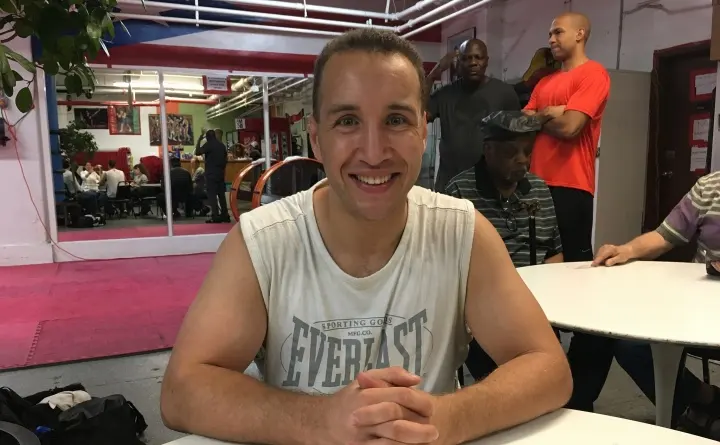
By Thomas Gerbasi
Boyd Melson has a way of making us all look bad. It’s not intentional, of course, but one look at the body of work he’s compiled in a little more than 36 years on this Earth can make you question some of the decisions you’ve made in life.
Like the first responders who run to danger and not away from it, the former junior middleweight prospect from New York has always opted to give and not receive. Whether it was the over $400,000 he raised for Spinal Cord Injury research or the positive steps he’s taken in trying to tackle the drug epidemic in Staten Island, Melson has made an impact that has nothing to do with the punches he landed in the ring en route to a 15-2-1 pro record.
His actions are a reminder that talking about things and doing things are quite different, especially in this day and age, and that being selfless, as opposed to selfish, can be inspiring.
Yet it was with an announcement made just after the New Year that Melson took things to another level, as he announced that he was withdrawing from his 2018 race for congress in order to be deployed to the Middle East to join Operation Inherent Resolve.
“I am proud of many things that have taken place in my life and lives of those around me,” Melson said in a press release. “The most important to me without question is being a great American that stands behind his responsibilities as a member of the Army Reserve.”
A 2003 graduate of West Point, Melson earned the rank of Major in the Army Reserve, a gig he kept over the years despite success in the ring that saw him win three U.S. Armed Forces titles, a 2004 World Military Championship and a Silver medal at the 2006 U.S. Championships. Among the fighters he defeated as an amateur were future world champion Keith Thurman, Charles Hatley and Deandre Latimore. And while he showed promise as a pro, his sights were never set on glory in the ring, but on bringing awareness to the issues that meant something to him. And he put his money where his mouth was, donating all his purses to such causes, primarily to spinal cord research, a fight that began when he met a young lady named Christan Zaccagnino in 2002.
A diving accident paralyzed Christan when she was 10. Nine years later, fate brought the two together, they dated briefly, but throughout it all, Melson fought for Christan to walk.
In 2011, before his win over Hector Rivera, I spoke to Melson about his motivation.
“I don’t know how to stop living without chasing this with her and fortunately, it’s not just her that it benefits,” he said. “I’ve invested the last eight, nine years of my life to get her out of this chair and walking and it’s turned into a quest for all people who suffered spinal cord injuries to get them out of their chairs.”
And boxing was his way to do it.
“Boxing allows me to express myself and it’s also something I think I’m good at, so you always tend to lean toward things you’re good at,” said Melson. “I also want to see how well I can do in this and I want to become a very loud voice for spinal cord injuries and for our disabled veterans. I want to try and help use my success in the ring as a platform, so I figure that if I can do well in this sport, people will listen to what I have to preach.”
They listened, with Melson’s story one that was impossible to ignore. For the next four years, he told it, not willing to take the spotlight for himself, but to shine it on those who needed it a lot more. In May 2015, he scored a 10-round decision over Mike Ruiz, picked up the WBC USNBC title, his first as a pro, and retired.
A year and a half later, he was back. It wasn’t because he had something left in the basement, but because he had another cause that he wanted people to know about. He was about to announce that he was running for a congressional seat in Staten Island, with his focus on the drug epidemic tearing through the borough. And what better way to bring awareness to the problem than by trading punches?
“When I was working towards trying to bring attention to paralysis, I saw what the difference would be every time I had a fight coming up versus no fight coming up,” he told me before the November 2016 fight. “And when I had a fight and I wanted to voice my opinion, I noticed how people congregated around a lot more when they knew I was fighting. Boxing doesn’t have a league, so unless you’re a world champion, there are only a couple people who can still garner enough attention in the sport where if they do something in the public eye, people are going to surround it.”
Melson lost that fight, getting stopped for the only time in his career by Courtney Pennington, but he achieved his goal and remained in the public eye as he began his run for congress, drawing positive notices on the political scene as a Democrat to watch.
But when a member of Melson’s reserve unit who was scheduled to be deployed this year was contacted about an opportunity for an assignment in an Active Guard Reserve position that she had been hoping for, the former prizefighter and aspiring politician stepped in. After three previous deployments fell through, this one didn’t. Melson was going to take his squadmate’s place
“I have never deployed,” Melson said in the January press release announcing his withdrawal from the 2018 District 11 congressional election. “Wholeheartedly, I believe that it is my ultimate duty to serve this great country in our fight against ISIS in the Middle East…While there’s no doubt in my mind I was the right man to lead Staten Island and South Brooklyn, America needs me overseas. I was doing well in my campaign run…Then I received a phone call. A fellow soldier was scheduled to deploy. She asked me if I would switch with her because of various circumstances that would greatly benefit her family's life to include her. I immediately said yes.”
Back in 2011, we talked about his time at West Point and in the reserves. Again, it turned into a discussion that wasn’t about him, but about the men and women he served with.
“I carry my classmates with me every time I go into the ring,” Melson said. “I was fortunate enough to never have to get deployed. A couple of them have been killed, a lot of them have been injured, and they sacrificed their time by going out there when I got to go home every night. I think about that every day.”
He doesn’t have to think about it anymore, as he will soon be with them, doing their part to make the world a better place for everyone to live in. The response to Melson’s announcement from his peers in the boxing community was immediate, with everyone from Thurman, Shawn Porter, Oscar De La Hoya and Deontay Wilder to Evander Holyfield, Paulie Malignaggi and Bernard Hopkins all sending him video messages of encouragement.
And as Melson and his fellow soldiers prepare to head out, it brought to mind the announcement that “The Contender” series was being brought back to television by way of the Epix network.
Back in 2005, when the first season was about to air, I had a fit – and rightfully so – when the creator of the show, Mark Burnett, had the following to say in an interview with IGN.
"Nobody cares anymore about boxing, because nowadays boxers are felons or just unlikable characters,” Burnett said. “This show is our first step in changing that."
It hit a nerve with me then and it still does now, 13 years later. Yes, boxing has felons and unlikable characters, just like every sport and every job does. But boxing is home to some of the finest people I’ve ever met. Boxing produced Boyd Melson, and I hope Burnett knows that before heading into production for the next season of his show, because as long as there are people like Melson, there is hope.
You won’t hear that out of his mouth, though. That’s not his way.
“I thought to myself, I have never been deployed and I don’t want to look back on my life thinking how I had my chance to do my part fighting ISIS but shied away from it,” Melson said earlier this year. “That would have gone against everything I stand for. I believe in sacrificing myself to help others. This time, the sacrifice is not only to help combat the terror in the Middle East, but to also help out a fellow soldier. If I said no, I would have lied to myself about who I think I am and what I think I am about.
“I have spent a great amount of time over the years traveling to schools and speaking to students from pre-k through college,” he continued. “I always stated that you must make sure that your decisions are in alignment with your heart's values. Me not being there when called upon would have meant I would have lied to these children all of these years. I finally am getting my chance to join my brothers and sisters in arms with this experience.”