"Better Late Than Never" For HBO Boxing To Air Hardy-Vincent

Oct 8, 2018 • 1:55 AM ET

By Corey Erdman
However one chooses to describe HBO’s departure from boxing on October 27, one thing is certain—the network knew times had changed.
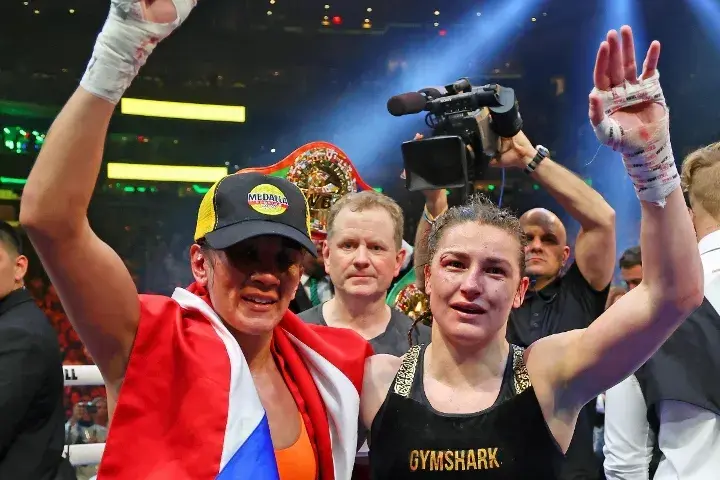
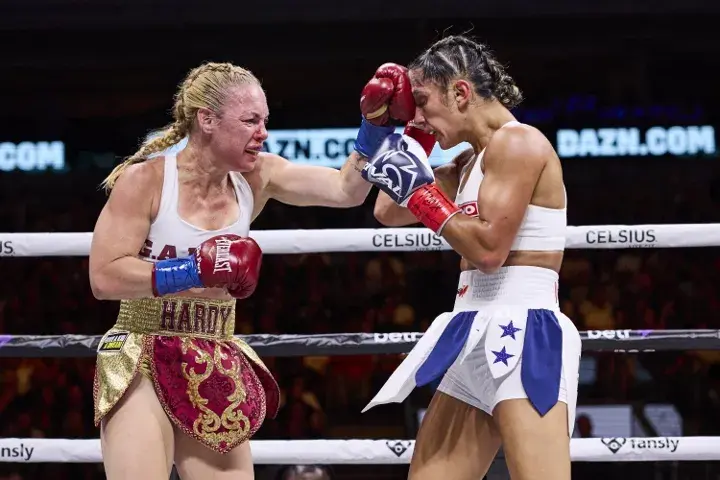
This past week, the network formally announced that the rematch between Heather Hardy and Shelly Vincent would be included on what is, at least for now, the final HBO boxing telecast. It’s an admission, albeit at zero hour, that the network had fallen behind the times in some respect. While Showtime and ESPN had committed to featuring women’s boxing on a regular basis, HBO lagged behind, with the exception of the dramatic Cecilia Braekhus-Kali Reis bout. The network had a chance to sign a deal with Claressa Shields, however, it chose to relegate her pro debut bout on the undercard of Andre Ward-Sergey Kovalev I—the source of much mainstream attention for the card itself—to a non-televised free web stream.
After promoter Lou DiBella hounded HBO boss Peter Nelson for months to add the bout to the October 27 broadcast, it was a last minute personal plea from Hardy herself that finally convinced Nelson to air the fight. According to Yahoo Sports, Hardy told Nelson, "I’ve worked my ass off at a time when women’s boxing wasn’t taken as seriously as it is now...I’m really asking you to help me out here. I know you have the power to do it.’ ”
"It's big for their exposure, and for the exposure of women's boxing. The first fight was a Gatti-Ward type of fight. If it's as good as the first fight, it's good for both fighters," said DiBella. "I'm glad that as they exit the business that they made a decision that will help to advance the sport. It's better late than never."
As wonderful as it is to see Hardy and Vincent get their due, the fact that the network had to be begged and guilted into air the bout is indicative of the mindset that ultimately led to its departure from the Sweet Science. It’s not editorializing to say that complacency led to the departure of HBO from the boxing space—in fact, it’s the company line—Nelson himself said that it was simply a business decision. Through numbers had certainly dropped, when HBO did air notable bouts, it still notched some of the most-watched boxing telecasts in the United States this year.
However, with a smaller budget than it was used to, and mounting competition coming from seemingly everywhere, HBO was unwilling to battle for its spot as the industry leader.
There was a time, not that long ago, when HBO was not just the industry leader, but was one of few games in town. For many years, HBO was considered the big leagues, with ESPN serving as a feeder system for future stars and a fallback for aging ones. Even its closest competitor Showtime was, for the sport’s biggest stars, the second choice in terms of networks they would like to appear on.
Perhaps HBO’s biggest flaw was taking this position a little too seriously—to the point that it effectively pretended boxing didn’t exist outside of its own airwaves. For years, HBO acted the way the WWE acts towards professional wrestling at large. In WWE, there is an admittance that wrestling exists somewhere else—new wrestlers have to come from somewhere—but it’s rarely acknowledged exactly where. HBO long employed a similar strategy—fighters didn’t exist until they were on their channel. In recent years, Jim Lampley’s “The Fight Game” news program would make mention of fighters on other networks, but given the competitive climate, still photos were used to show them in lieu of footage from other networks.
Until the past five or six years however, the “only game in town” strategy worked because it had logistics on its side. Not only were there very few other broadcast entities in North America airing boxing, but the hundreds of hours of boxing being televised elsewhere in the world was tough to access. Early on in my career in boxing journalism, I felt like I was the only one who was watching minimumweight fights from Thailand or flyweight scraps from Mexico on bootleg streams. Nowadays, I can log onto Twitter and have lengthy debates about those same types of fights in real time if I so choose, because everyone’s watching them. HBO was simply late to the party when it came to fighters in smaller weight classes, just as it was with women’s boxing.
The faux insular universe is reliant upon a lack of knowledge and access—and today’s boxing fans are more knowledgeable and have more boxing at their disposal than ever. As a result, the demand for volume has changed. There’s a lot of boxing on, everywhere, every single week, and airing cards once every few months—often featuring fighters inferior to those appearing on other networks—wasn’t going to be a winning strategy anymore.
The outpouring of nostalgia and emotion from boxing fans regarding HBO’s exit is not because there’ll be less boxing to watch—there’s already more than can be consumed in a weekend almost every week. It’s because when HBO did air boxing, regardless of how diminished the product was, it was still HBO. The network set and held the standard for televised boxing production right up until its decision to walk away. But in the end, what boxing fans want is a fight, and HBO didn’t have any to give—in more ways than one.