Anthony Joshua and Deontay Wilder Have A Lot To Lose

Jul 28, 2018 • 1:58 AM ET
By Michael Rosenthal
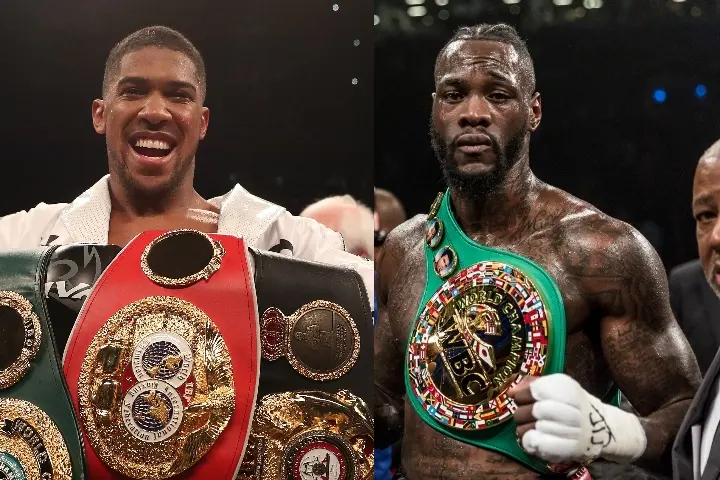
Anthony Joshua and Deontay Wilder probably will reach a deal at some point to fight next year.
Joshua probably will beat Alexander Povetkin in September and Wilder probably will do the same against whomever he fights later this year, which probably will set up a massive Joshua-Wilder showdown in April 2019.
Probably. One never knows in this game.
Joshua and Wilder are playing with fire by failing after months of negotiations to reach a deal for a heavyweight unification bout this fall, which is one of, if not the biggest-possible events in boxing.
Some have suggested that the matchup will only get bigger in the months ahead but I believe the time is now. Joshua is a huge figure in the U.K. and, let’s face it, the only way Wilder will resonate in his home country, the U.S., is if he defeats Joshua.
They’re both undefeated – a mindboggling 61-0, with 59 knockouts, between them. That’s one of the elements that makes this matchup so compelling.
One of them could lose and spoil the whole damn thing. I don’t think much of 38-year-old Povetkin but the one-time amateur star has lost only once (to Wladimir Klitschko) in his 13-year career. And he’s a legitimate heavyweight, meaning one punch landed just right could derail Joshua’s career. I don’t know who Wilder will face – Dominic Breazeale? – but you always risk losing when you step into the ring, particularly in that division.
In other words, both fighters are at their peaks and that doesn’t last forever.
We don’t need to rehash all of what we know about the failed negotiations. These are the basics: Joshua promoter Eddie Hearn offered Wilder $12.5 million to fight in the U.K.; Wilder’s team countered by offering Joshua $50 million to meet in the U.S.; Joshua then raised the $12.5 million offer to $15 million.
The only offer reportedly accepted was that $15 million, although Hearn claims Wilder’s inability to finish the deal in a timely manner prompted the WBA to order Joshua to defend his WBA belt against Povetkin. He accepted. Shelly Finkel, Wilder’s advisor, disputes Hearn’s scenario. He said he would’ve met the deadline had he been given one.
The fall out was no surprise: The fighters and their camps claimed after the contentious negotiations that the other side was never serious about making the fight, a refrain we’ve heard many times.
That brings me to my second point: There are no guarantees that a second round of negotiations will produce an agreement after the first round failed so miserably, which could push the showdown back even further and continue to frustrate fans.
I understand the instinct to make as much money as possible given the immense risk the fighters will face against one another. One of them is likely to get knocked out, which would damage his earning power going forward. It’s imperative that their handlers make the right deal.
The problem is that the right deal for one fighter often is the right deal for the other.
The fact is that Wilder needs Joshua more than Joshua needs Wilder from a business standpoint because of Joshua’s star status in his home country and another of his options for a megafight: former heavyweight champ Tyson Fury of the U.K., who Joshua said he is willing to fight.
Joshua and Fury could fill 90,000-plus-seat Wembley Stadium to the rafters for what would be the biggest and most compelling all-British heavyweight matchup in history, meaning it would rival or even surpass the riches Joshua-Wilder could generate.
It’s also probably an easier fight for Joshua, although Fury would pose a serious threat if he can replicate his title-winning performance against Klitschko way back in 2015.
Joshua, who holds the IBF, WBA and WBO belts, genuinely wants to unify all the major titles – Wilder is the WBC beltholder – but a huge fight against a high-profile, loquacious and vulnerable local rival in the meantime would be a fine altnerative.
The problem is that I don’t think Fury is ready or even willing to fight either Joshua or Wilder in the next six months, although I can’t predict how he would respond to a big-money offer. It seems to me his job now is to rebuild after 2½ years out of the ring and take on one of the big boys when the time is right for him.
Indeed, Fury has said that he will fight Joshua or Wilder on his schedule, not theirs.
That brings us back to Joshua vs. Wilder. Hearn has said that the $15 million offer is still on the table, although it would be for a fight in April. He seems optimistic that the fight can happen then. And I have to think that Wilder, seeking a major breakthrough, wants the fight as soon as possible.
The $15 million offer seems low to me. Perhaps Hearn and Co. could raise that figure to a point where Wilder can’t refuse and we’ll have our epic heavyweight battle.
Indeed, let’s hope that greed or stubborn pride or overplaying one’s hand or any other obstacle doesn’t destroy the chances of such a captivating matchup being made. They don’t come along very often.